
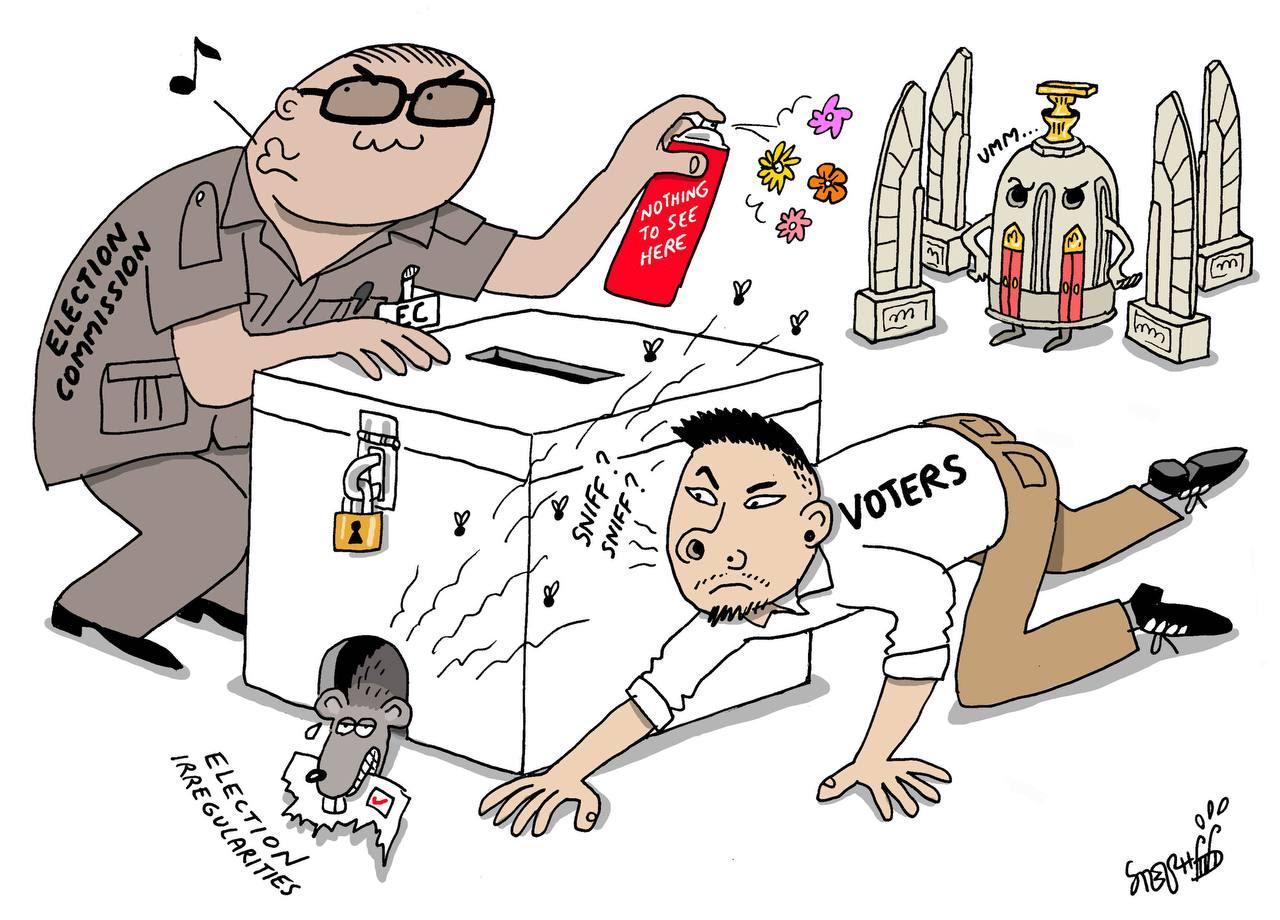
Stephff's world
The geopolitics of artificial intelligence
Book talk,
Wednesday, 25 February, 12pm

Artificial intelligence is no longer merely a technical tool — it is rapidly reshaping global power, competition, and cooperation.
‘Geopolitics of Artificial Intelligence’ explores how AI is transforming relations between states, corporations and societies, creating significant economic and governance opportunities while also generating new risks, from intensifying geopolitical rivalries to the erosion of global cooperation and threats to sovereignty and democratic self-determination.
The book argues that existing political and regulatory frameworks are ill-equipped to address these challenges, as AI risks and geopolitical tensions increasingly reinforce one another — often driven by powerful non-state actors like technology firms. It proposes a new ethical and governance framework grounded in shared responsibility, structural justice and global equality, offering a vision for managing AI’s benefits and harms more fairly in an unequal world.
Join the FCCT for a discussion with the book’s two authors.
Brian Wong is an HKU-100 assistant professor of philosophy at the University of Hong Kong and a non-resident honorary fellow at the Asia Society Center for China Analysis. A Rhodes scholar, his research spans geopolitics, technology ethics and authoritarian governance, and his commentary on China and Asian geopolitics regularly appears in leading international media.
Boris Babic is an associate professor of data science, philosophy and law at the University of Hong Kong and a principal investigator at the AI and Humanity Lab. His research focuses on the ethics, law and policy of artificial intelligence, including generative AI, and has been published in leading journals such as Science and Nature Machine Intelligence.
Moderator: Panu Wongcha-um, FCCT president and Reuters senior correspondent
Members who wish to book in advance should email info@fccthai.com or call the FCCT office on 02-652-0580.
Non-members can use this link.
Members and Thai media professionals free, non-members 350 baht; students with ID 150 baht.Bar and restaurant open.
The future of development cooperation: Opportunities and challenges in Asia-Pacific and beyond
Panel discussion,
Wednesday, 25 February, 6.30pm
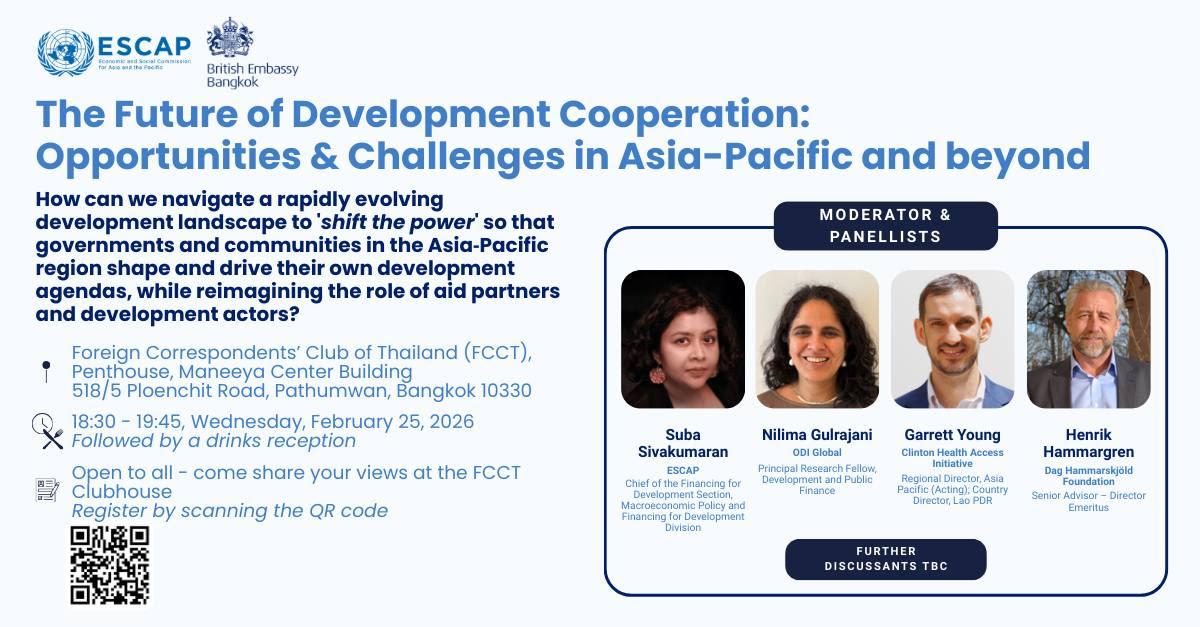
In recent years, the development landscape has seen unprecedented changes to its structure and system. Compounded by increasingly limited foreign aid contributions from traditional donors, amplified doubts about the effectiveness of multilateral mechanisms, and the fragility of the current world order, the future of development cooperation faces new challenges – but also new opportunities.
As the traditional donor-recipient structure undergoes transformation, questions remain as to how development efforts can diversify and sustain their funding. What technological advancements can support this transition, and how can the Global South be empowered to champion their own development? What role can development partners play in this new landscape?
By convening government representatives, civil society, academics and journalists from both the Asia Pacific region and beyond, this roundtable seeks to foster an effective platform to promote productive discussions and collaboratively forge a way forward amidst growing global development demands and emerging alternative forms of foreign assistance.
Join us in the FCCT clubhouse, to hear from:
Nilima Gulrajani, principal research fellow of development and public finance, Overseas Development Institute (ODI Global), and Donors in a Post-Aid World programme lead;
Garrett Young, regional director, Asia Pacific (acting); Country director, Lao PDR, Clinton Health Access Initiative (CHAI)
Henrik Hammargren, senior advisor/ director emeritus, Dag Hammarskjöld Foundation;
Panel discussion moderated by Suba Sivakumaran, chief of the financing for development section, macroeconomic policy and financing for development division, ESCAP.
Further discussants to be confirmed.
The event will be open to all, with the panel discussion followed by a drinks reception.
Register by scanning the QR code in the flyer.
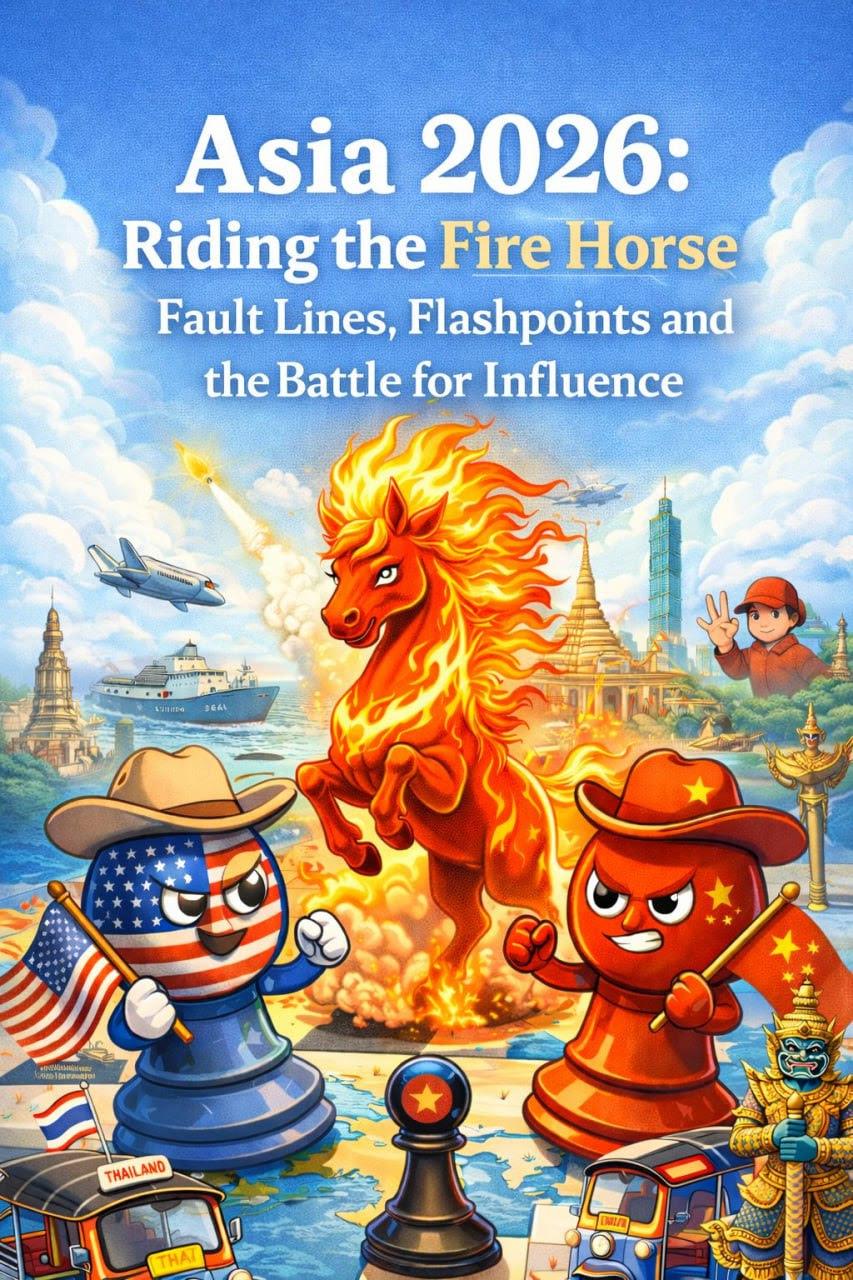
Asia 2026: Riding the fire horse - fault lines, flashpoints and the battle for influence
Panel discussion
Thursday, 26 February, 7pm
Asia enters 2026 facing one of its most complex and consequential geopolitical landscapes in decades. From intensifying rivalry between the United States and China to regional security flashpoints and domestic political transitions, the balance of power across Asia is shifting in ways that will shape global politics, trade, security and human rights in the years ahead.
Conflict and instability remain central concerns. Myanmar’s ongoing civil war continues to destabilise the region, driving humanitarian crises and cross-border tensions. Thailand faces political uncertainty at home while navigating its position between major powers. Across Southeast Asia, the South China Sea remains a persistent security flashpoint, while tensions around Taiwan, the Korean Peninsula and broader Indo-Pacific military dynamics add further layers of risk and uncertainty. Region-wide nations big and small are needing to decide whether to stand up to Donald Trump’s tariff baton or resist retaliatory actions. It’s a troubling era which Singapore Prime Minister Lawrence Wong described as “more volatile, with more frequent and unpredictable shocks. One where the risks are real and the stakes are high.”
Environmental instability is also increasingly shaping political realities across the region, as climate-driven disasters, resource pressures and displacement intersect with governance, security and economic resilience.
At the same time, Asia remains pivotal to global economic growth, climate strategy and technological competition. How will the non-interventionist region bloc, ASEAN, respond to deepening divisions among major powers? What role will middle powers play in a more fragmented global order? And where do human rights, democratic movements and civil society fit into a region increasingly shaped by hard-power politics?
In the year of the fire horse - traditionally associated with turbulence and transformation – our panel of experts and journalists will unpack the forces reshaping Asia in 2026 and what they mean for the region and the wider world.
This event is curated by The Media Connector, a London-based media and events consultancy working across global affairs, journalism and public dialogue.
Join us in the FCCT clubhouse, to hear from:
Michael Bociurkiw, Global affairs analyst, senior fellow at the Atlantic Council and Founder of World Briefing report on Substack.
Victor Mallet, senior editor of world news at the Financial Times and a former FT Asia editor and Paris bureau chief.
Thitinan Pongsudhirak, professor of international relations at Chulalongkorn University and senior fellow at the Institute of Security and International Studies
Huizhong Wu is a correspondent at Associated Press covering China and Southeast Asia, formerly correspondent in Taiwan.
Ayla Jean Yackley is a freelance journalist based in Istanbul who writes primarily for the Financial Times. A former Reuters correspondent, she covers politics, economics, and culture, with reporting experience across the Middle East, Europe, and the Caucasus.
Members who wish to book in advance should email info@fccthai.com or call the FCCT office on 02-652-0580.
Non-members can use this link.
Members free, non-members 450 baht, students and Thai press with ID 150 baht.Bar and restaurant open.
Asia's security order in flux: the role of US allies
Monday, 16 March, 2pm
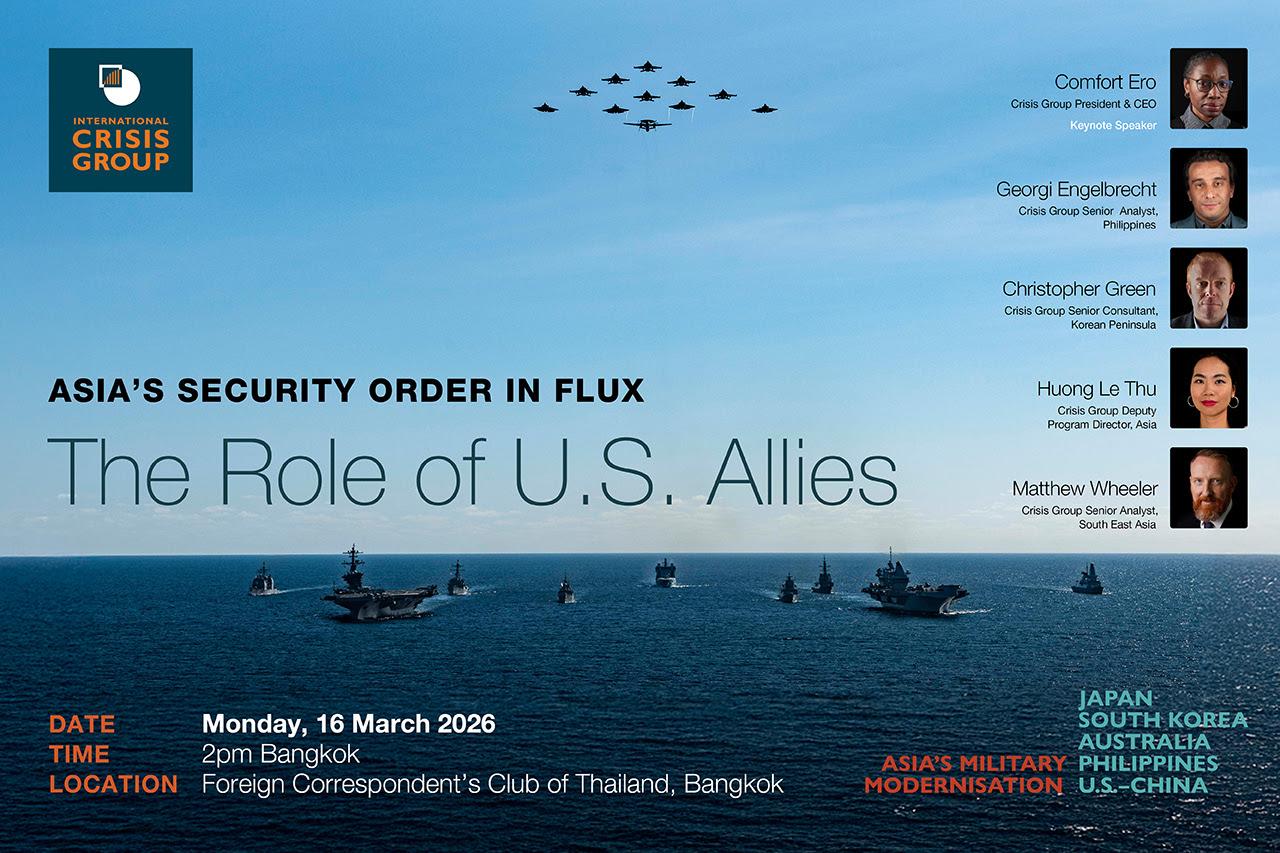
As the global order shifts, longstanding security arrangements in the Indo-Pacific are under strain. Power balances are changing, alliances are being tested and key regional partners are rethinking how they deter threats and protect their interests. From Tokyo to Seoul, Canberra and Manila, the US’s Asian allies are reassessing their reliance on external security guarantees and their own deterrence capabilities. This panel brings together International Crisis Group analysts to unpack how defence postures across the region are evolving and what these changes mean for the future of the Indo-Pacific security order.
Comfort Ero, president and CEO of the International Crisis Group will deliver opening remarks.
Panelists:
Georgi Engelbrecht, senior analyst, Philippines
Christopher Green, senior consultant, Korean Peninsula
Huong Le Thu, deputy director, Asia Program
Matthew Wheeler, senior analyst, South East Asia
To attend this event, please RSVP here.
This is not an FCCT event.
Co-working at the FCCT
Tuesday, 24 February, 10am

Need a change of scenery from your home office? Join us for a coworking day at the Foreign Correspondents’ Club of Thailand (FCCT) -- a perfect space for working professionals, digital nomads and anyone looking to break free from the home-office routine.Enjoy a spacious, comfortable workspace with dedicated tables, a full restaurant, café and bar and exclusive lunch specials just for this event.Whether you're tackling deadlines or networking with like-minded professionals, this is an opportunity to be productive in a collaborative, social environment. Come work, connect, and enjoy great food because working remotely doesn’t have to mean working alone.Hosted by Tommy Walker, FCCT board member and digital nomad.
Free and open to all.Bar and restaurant open.
Board games night
Tuesday, 24 February, 7pm

Join us for a chilled night of board games with The Boring Club. Try your luck with classics like chess and backgammon or modern games including Catan and Pandemic.The bar and restaurant will be open. Try our pizzas from the new pizza oven. The Boring Club meets at the FCCT clubhouse for games every Tuesday at 7pm.
Free and open to all.Bar and restaurant open.
FCCT pub trivia
Friday, 27 February, 7pm

Gather your friends and colleagues for a night of pub trivia at the Foreign Correspondents' Club of Thailand.Come for a bite and a beverage and test your knowledge. 1,000 baht bar tab up for grabs for the winning team, to be redeemed on the night.Advanced table bookings encouraged here.
Free and open to all.Bar and restaurant open.