
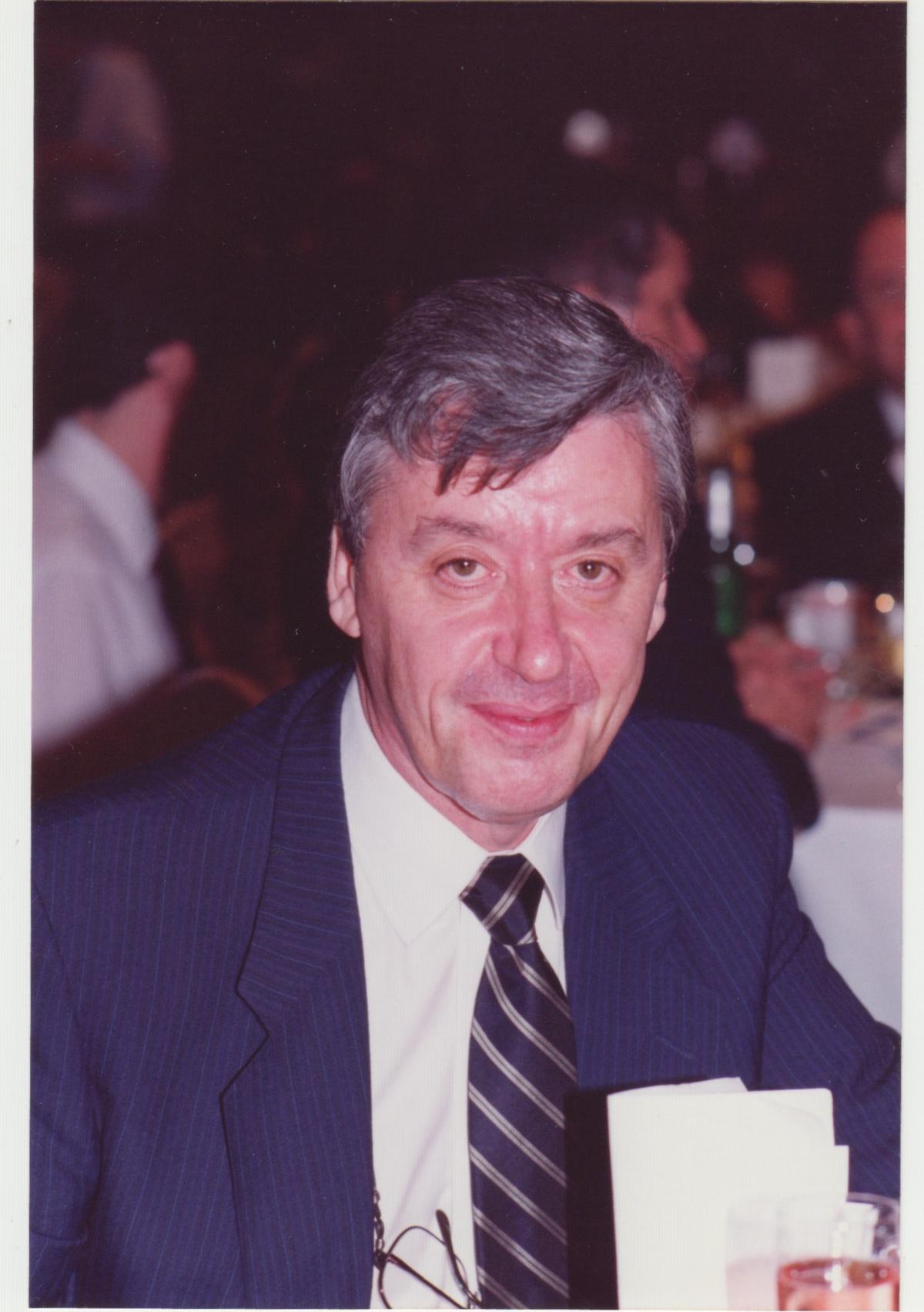
Charles-Antoine de Nerciat, Agence France-Presse's Bangkok bureau chief in the early 1990s, has passed away in Paris after a long illness.
The Foreign Correspondents' Club of Thailand expresses its deepest condolences to the family, colleagues and many friends of Charles-Antoine de Nerciat, who has died after a long illness in Paris. He was 83, and his funeral was held there at the Church of Saint-Honoré-d‘Eylau on 19 July.
During a distinguished career, Charles-Antoine was a correspondent with Agence France-Presse in Vietnam and Cambodia in the closing years of the Vietnam War. He was AFP’s bureau chief in Bangkok from 1988 to 1993, a momentous period in the region that saw booming economic development alongside major political upheavals.
Those included a nationwide pro-democracy uprising in August 1988 in neighbouring Burma, as Myanmar was still known, and a coup in Thailand in February 1991, followed by a massive counter-military uprising in May 1992. There were also major steps forward in the Cambodian peace process that led to the Paris Peace Accords in 1991, the establishment of the United Nations Transitional Authority in Cambodia in 1992 and the UN-organized general election in 1993 that produced the two-headed government of Prime Ministers Prince Norodom Ranariddh and Hun Sen -- with Prince Norodom Sihanouk acting as midwife.
The AFP bureau in Bangkok was a hive of activity in those tumultuous, unpredictable days. Hard-charging American Michael Adler, followed by the legendary New Zealander/Australian Kate Webb, served as deputy bureau chiefs. The shrill invective of Khmer Rouge radio was monitored in a back office, attacking the “two-headed, three-eyed” government of Ranariddh and Hun Sen with his glass eye. Some years after Charles-Antoine’s departure, another deputy bureau chief, Mark Lavine, would finally report correctly the death of Pol Pot from the same premises -- after a number of false alarms.
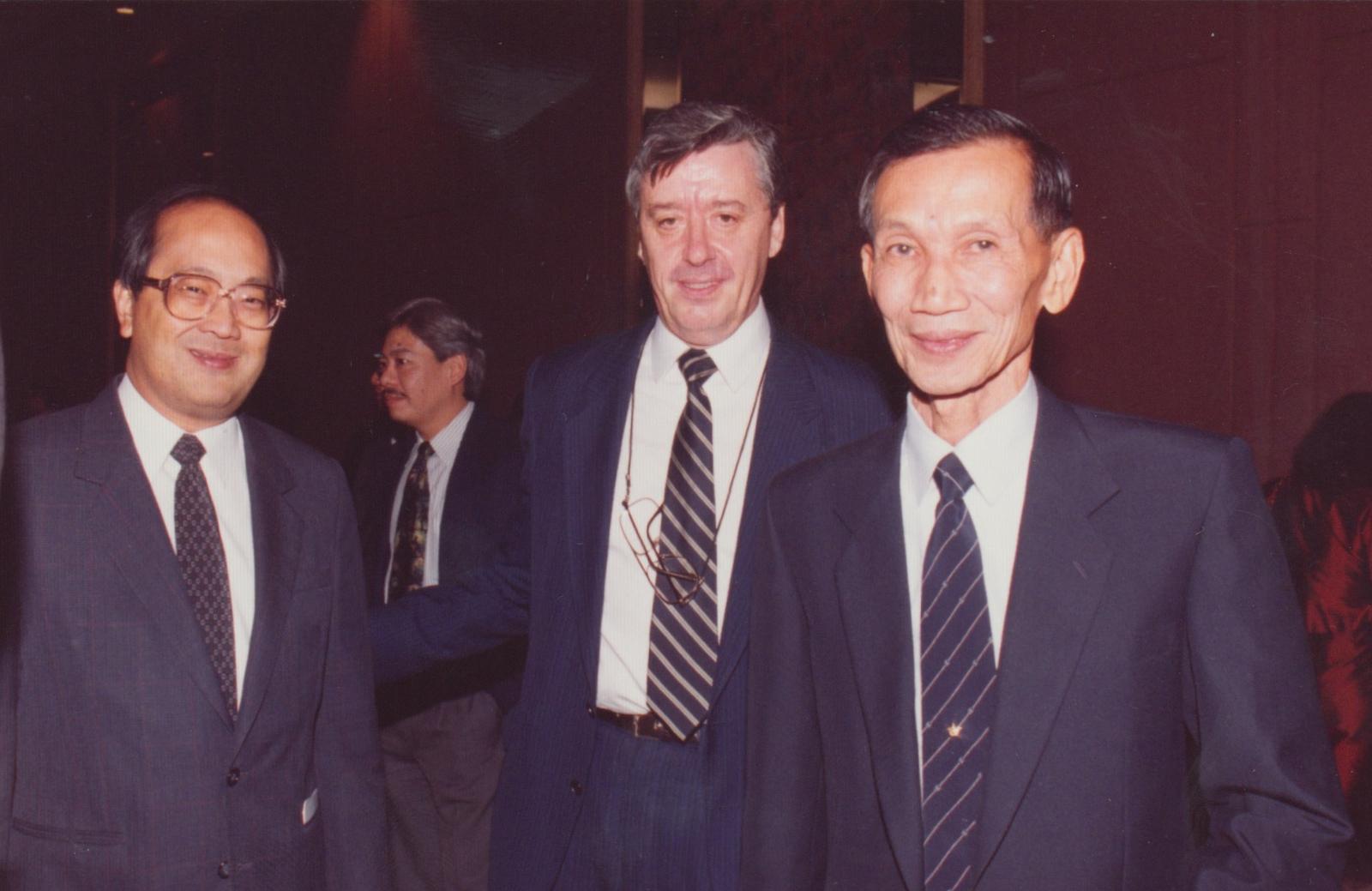
Charles-Antoine de Nerciat in 1992 with Squadron Leader Prasong Soonsiri, right, Thailand's soon-to-be foreign minister, and Sakthip Krairiksh, left, director general of information at the Ministry of Foreign Affairs.
“My main recollection of Charlie was that he was friendly, appreciative and supportive -- and that he had voluntarily stepped out of a management position at AFP to get back into the field at a time when he correctly anticipated that everything was going to change in Cambodia,” recalled Michael Shari, an American who reported for AFP from 1987 to 1991. “He also knew all the journalists portrayed in the film ‘The Killing Fields’ and introduced me to a few of them.”
“Charles ran a happy Bangkok bureau in the early 1990s,” recalled Robert Birsel, a British AFP reporter from 1991 to 1993 who went on to Reuters. “He was always kind and supportive and never raised his voice or was short with anyone. His passion was the Cambodia story and we knew we had to scour those daily Khmer Rouge radio transcripts for anything new. He would pore over Prince Sihanouk's bulletin, invariably finding some arcane angle that he would write up in both English and French, taking quiet satisfaction the next morning when the 'controls' showed the story got play. It was Charlie who first encouraged office assistant Anusak Konglang to get into reporting. Anusak went on to become the rock of the AFP Bangkok operation for years.”
“Charlie, as his AFP anglophone colleagues called him, was also known as Charles-Antoine, baron Andréa de Nerciat, a title he almost never mentioned,” recalled Michele Cooper, his successor in Bangkok.” It was rare for an American or any other foreigner to become an AFP bureau chief, but so was Cooper’s perfect French.
“My first encounter with Charles was at AFP headquarters in Paris, when he breezed into the news room after having been expelled from an African country, if memory serves,” Cooper recalled. “His hair was long and stringy and his dress, disheveled. But when he approached the English-language desk, he addressed editors in perfect Oxford English, with manners to match. That side of his character became more apparent with the years, and by the time he met and married Mary, he was the image of a dapper English gentleman.”
Although he did not advertise it, Charles-Antoine’s contacts in the Thai capital were good enough for him to be granted an audience with King Bhumibol Adulyadej when the editor in chief from Paris visited. It did not hurt that the king grew up in Lausanne, Switzerland, and preferred to converse in French rather than English.
“Charles-Antoine was definitely an aristocrat,” recalled Elizabeth Becker, the distinguished American Cambodia correspondent and author. “He inherited his father’s title as well as a chateau. His widow is Mary, the wonderful Canadian woman he met in Indochina and who took great care of [him]. He suffered for over a decade of debilitating illness. The last time I visited him and Mary was pre-pandemic. I had invited them to a wedding party in Paris for my daughter and her French fiancée. By then Charles-Antoine was more or less restricted to their home in Paris so that was the only way to see them.”
Becker recalled Charles-Antoine’s first days in Phnom Penh: “He was completely bilingual and although somewhat reserved at first, he broke the ice at our nightly (non) briefing by arriving wearing a black cape over jeans and a tee-shirt. He loved the Rolling Stones. It didn’t take long to realize he was a serious journalist. I read his stories for his ability to put military news in political context.”
“He was generous with colleagues, sharing his insights as well as his long list of contacts, and he was great company in all circumstances,” said Cooper, recalling his varied career “from French political reporter to head of the alert and analysis department toward the end of his career, in between postings to London, Beijing, Phnom Penh, Saigon and Bangkok. But his true love was reporting and particularly in Asia. He was forced to leave Phnom Penh as the Khmer Rouge advanced on the city, and then reported events in South Vietnam, staying on for almost a year after the government in Saigon collapsed in 1975 and Hanoi ordered the AFP bureau to close.”
“I was very sorry to learn of the passing of Charles-Antoine de Nerciat, a legendary figure at AFP, recalled Eric Wishart, a Scot who was AFP’s first non-French head. “Charles Antoine -- or CAN as he signed his stories and internal messages -- was head of the alert and analysis service when I was editor in chief from 1999 to 2005. He had a very fine news sense and served as my eyes and ears when I was running the global news operation. He closely monitored the competition and never hesitated to tell me if he thought we were getting the wrong angle on a coverage or missing the story. My days were punctuated by frequent notes alerting me to developments in coverage that were simply signed ‘CAN’. I had great respect for him professionally and was very fond of him personally.”
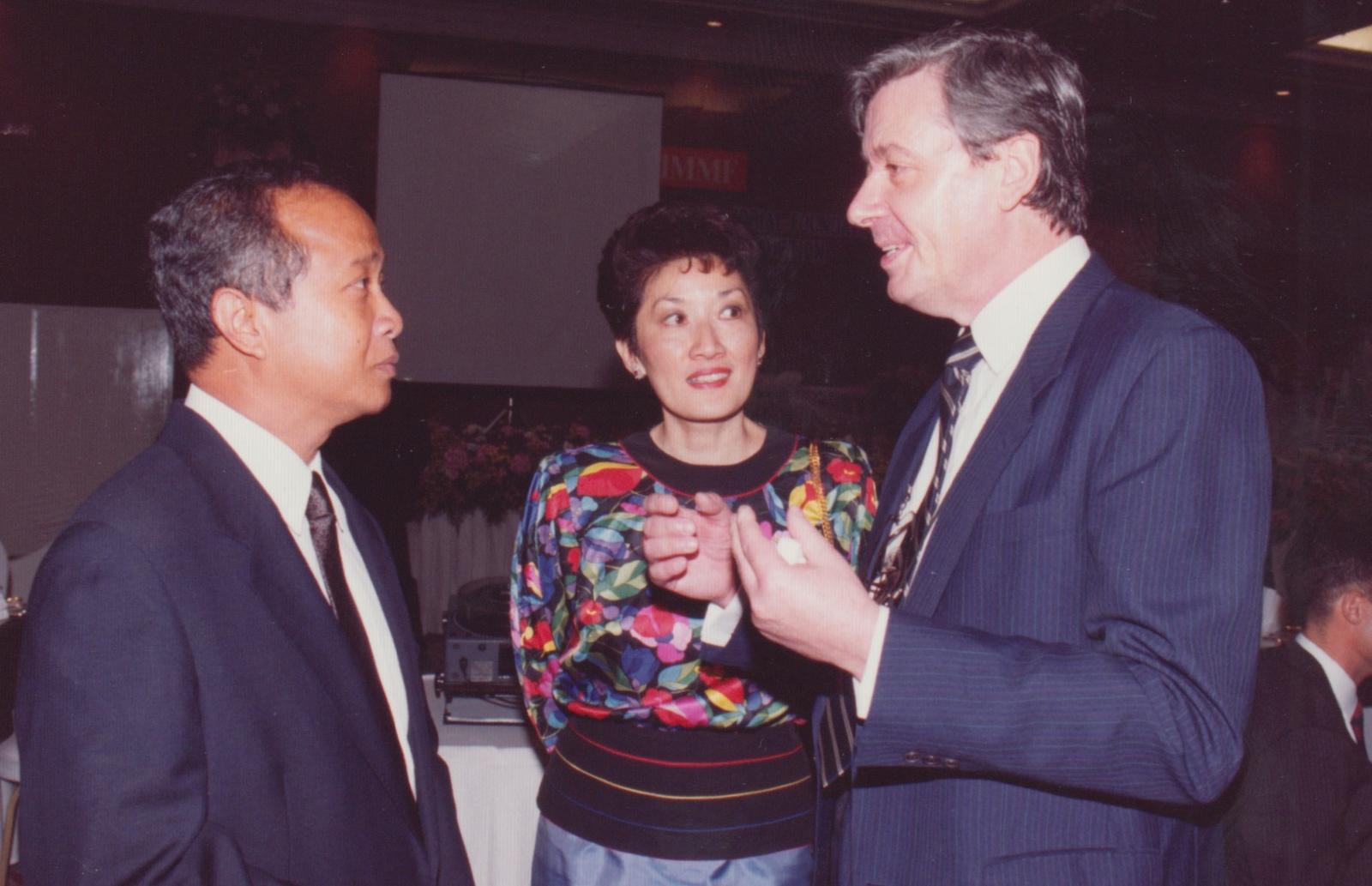
Charles-Antoine de Nerciat and his wife Mary with Prince Norodom Ranariddh, who would in 1993 become the First Prime Minister of Cambodia -- with Hun Sen serving as second prime minister.
During his time in Bangkok, Charles-Antoine was persuaded to serve as the founding president of the Indochina Media Memorial Foundation. The IMMF was started in 1991 by Tim Page, the English war photographer, author and counterculture notable of the Vietnam War era.
As IMMF president, Charles-Antoine presided over a memorable photo auction in 1992 in Bangkok that raised over US$ 40,000 to commemorate more than 320 journalists, mostly photographers, on all sides killed between 1945 and 1975 in Indochina. He brought gravitas, knowledge and charm to that unique event attended by Prince Ranariddh with his then wife Princess Marie, Thai national security hawk and future foreign minister Squadron Leader Prasong Soonsiri, half the diplomatic corps and just about every journalist in Bangkok.
After Charles-Antoine stepped down in 1993 to return to France, the IMMF in Bangkok (another branch in the UK focused more on pure photojournalism) went on to train some 900 young journalists from Cambodia, Laos, Myanmar, Thailand and Vietnam (plus one from China) under the project direction of Sarah McLean, a former British Foreign Office official, and co-presidency of Denis Gray and Dominic Faulder, both former FCCT presidents.
“My office was in the same building as the AFP bureau, and lunch with Charles was always special,” recalled Faulder. “He had great knowledge and insight, a true passion for journalism, and a delightful sense of the absurd. During an interview in 1989, Aung San Suu Kyi asked him incredulously if he had not read something or other she had written, and he responded, somewhat archly: ‘Well, as a matter of fact I have not.’
“Suu Kyi went frosty, and the scene Charles conjured up of the two foreign graduates bristling at each other in their perfect Oxbridge accents in hopeless, shattered Rangoon was unforgettable. Good relations were apparently restored at a diplomatic reception that evening.”
“I was not close to him but always liked him,” recalled Gray. “He bounced between Saigon and Phnom Penh during the war, and I saw him mainly in Cambodia. He had a reputation as a fine journalist. He was a rather dashing fellow, with some of that Gallic flair. In fact, I was a bit jealous of him once when I thought he was getting a bit too friendly with a girlfriend of mine -- and she with him. Given his aristocratic lineage, some of us called him "The Count" -- but in fun and in no way disparaging.”
Charles-Antoine de Nerciat was the author of ‘Bui Tin: De la reddition de Saigon à l’exil en France et à la dissidence’. [2000]