
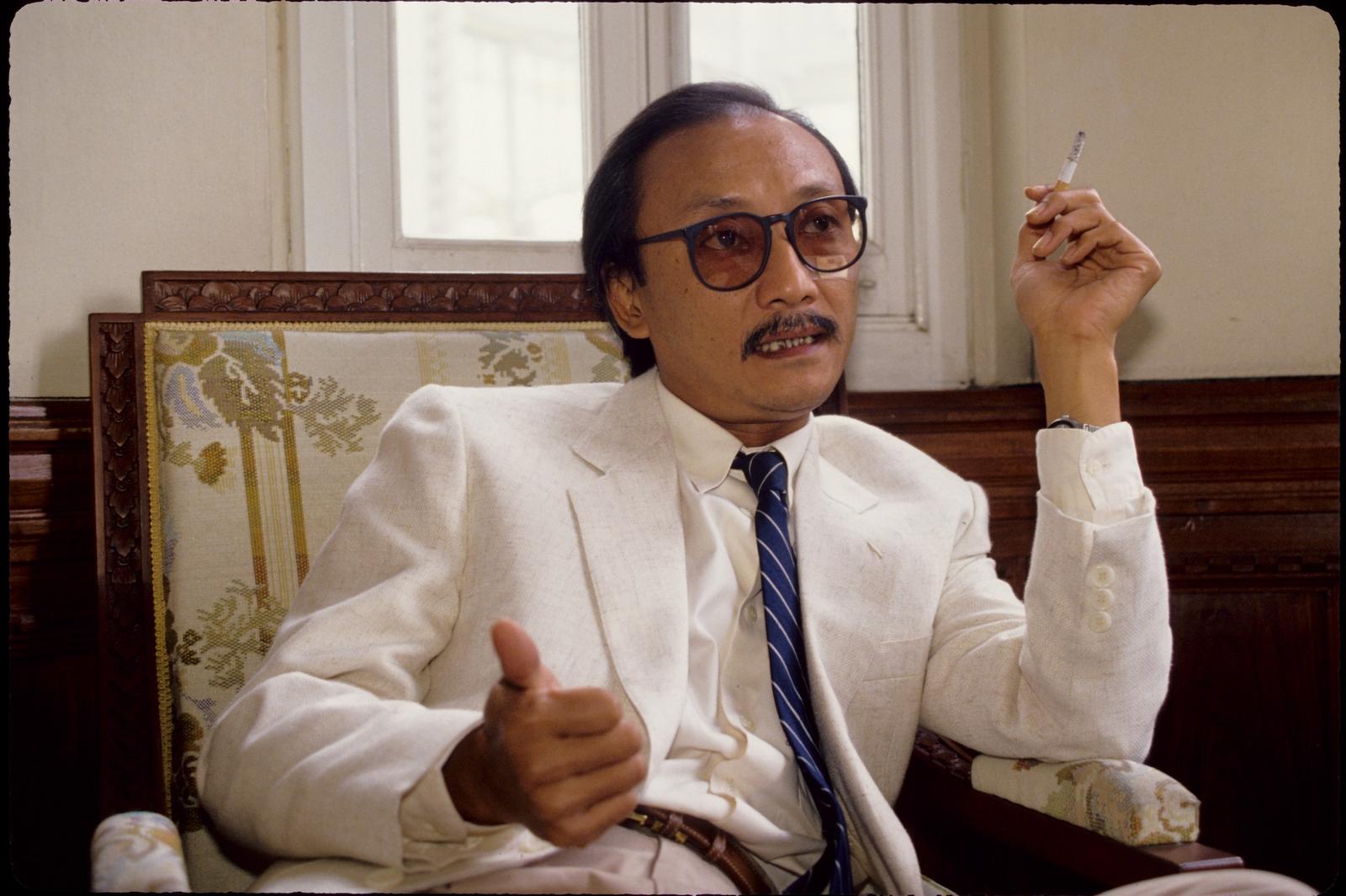
The Foreign Correspondents’ Club of Thailand expresses its deepest condolences to the family and many colleagues and friends of Kraisak Choonhavan, who passed away on Thursday evening after a long illness. Kraisak was a speaker at the club on many occasions.
The following short obituary has appeared in the Bangkok Post:
Kraisak held a bachelor’s degree in foreign relations from the George Washington University and a master’s degree from the School of Oriental and African Studies in England.
After finishing his studies, he taught at Kasetsart University in Bangkok before joining his father’s government as an adviser. He represented the Thai government at meetings to solve disputes in Cambodia and at peace talks in Cambodia, Laos and Vietnam.
After his father’s government was toppled by a coup led by Gen Sunthorn Kongsompong in 1991, the family went abroad. A year later, Kraisak returned and joined the 1992 uprising. He was elected senator for Nakhon Ratchasima in 2000 and chaired the Senate’s committee on foreign affairs. He joined the Democrat Party and was elected deputy party leader. He became a party-list MP in the 2007 election before Prime Minister Abhisit Vejjajiva dissolved the House in 2011.
He was diagnosed with cancer of the tongue in 2015 and died on Thursday, June 11, 2020, at Bangkok’s Siriraj Hospital.
++++++++++++++++++++++++++++++++++++++++++++++++++++++++++++++++
Kraisak (Tong) Choonhavan: An appreciationBy Michael Vatikiotis *
Tong and I led somewhat parallel lives. We both had influential fathers. His was Prime Minister Chatichai Choonhavan, who I used to share Bloody Marys with over lunch; mine was Tong’s professor at the School of Oriental and African Studies. We both studied in London when it was fashionable to be liberal and on the left. We shared the same musical tastes and enjoyed the same books. We had friends and experiences in common growing up in a world of ideas and possibilities.
I remember one of our first meetings in Bangkok when I was a journalist writing for the Far Eastern Economic Review. It must have been the mid-1990s. Tong didn’t like what the magazine was saying about Thailand, or more precisely, thought we could do some better reporting. After that, he became my guide and mentor on all things Thailand. He never steered me in the wrong direction.
The way to Tong’s heart was to talk about a cause. It didn’t matter what the cause was, just that it involved people as underdogs struggling against big men of power with no scruples. Tong saw these struggles from both sides of the barricade. In this sense, he came across as a man of contradictions. He railed against foreign media for their sympathies with the Red Shirt protestors who occupied Bangkok in 2010 and spoke from the yellow shirt stage; yet he was one of the few Thais to speak out fearlessly about human rights, corruption and the military’s abuse of power.
One day, he took me on a short walk to another house in the family’s sprawling Rajakhru compound. It belonged to one of his relatives who, as a powerful police chief, had abused people’s rights. Within the confines of his own home nearby, he rented parts of the compound to NGOs championing the rights of the disabled, or conserving waterways, forests or animals. Karma.
One of the more productive but frustrating periods of Tong’s career in politics, which was never completely successful, was as an advisor to the elected governor of Bangkok. He focused on environmental and cultural issues and used this period to try to do things for the city, whether it was something as mundane as garbage disposal or the establishment of the Bangkok Arts Centre.
As deputy leader of the Democrat Party, he struggled to make the rather staid and conservative Grand Old Party more progressive. He failed.
He boosted Thailand’s regional role in the 1980s and 1990s and was a founding member of the ASEAN Parliamentarians for Human Rights. He took an interest in the struggle for change in Burma and championed the cause of environmentalists in Thailand whose lives were threatened — and sometimes lost. As a senator, Tong conveyed a dignified, diligent approach. He used the platform to continue to support causes such as corruption in government and the environment.
In another life, Tong would have made a perfect revolutionary: He maintained a close relationship with the editors of the New Left Review. Then again, his mother was raised as a ward of the royal Thai court, and Tong’s upbringing was in close proximity to royalty. He was a staunch royalist, in spite of his leftist views. This put him in direct conflict with liberal foreigners and the populists close to former Prime Minister Thaksin Shinawatra. He moved easily in royal circles and knew how to harness the power of the crown to his own idealistic, humanistic goals.
Tong was a gifted artist and musician. As one of the very few Thais I knew whose home I could simply show up at unannounced, I often arrived while he was strumming chords on his guitar, or after he had finished a new painting. Tong introduced me to rebellious artists and musicians, like Chai Blues or Vasant Sittikhet, who treated him with such reverence that it was almost like being in some kind of royal court.
Tong had a remarkable talent as a peacemaker. In 2009, as deputy leader of the Democrat Party when he was an elected MP for Korat, he joined a discreet government effort to engage members of the armed insurgency in the Deep South, which I facilitated. For months, I watched him sit on the government side of the table, exuding empathy and goodwill towards the rebels, but never once departing from his government’s interests. I will never forget one evening on a beach in Bali when, after a long and arduous day of talks, the two delegations sat together for a barbecued fish dinner. Some wandering musicians stopped by to play. Tong asked for their guitar and started to sing songs of struggle. The simple humanity of this gesture for one brief moment bridged a deep gulf between Thais and Pattani Malays.
I would often go to Tong’s house in the early evening, arriving as twilight cast a bronze glow on trees that obscured the house. We would sit, talk and share a simple meal. Those were some of the most humbling and reflective moments of my life. Simple, uncomplicated companionship, which, all things said, was Tong’s greatest talent: boundless compassion and humanity.
Michael Vatikiotis, a former editor of the Far Eastern Economic Review, was president of the FCCT in 1996. Since 2005, he has been Asia director of the Geneva-based Centre for Humanitarian Dialogue.