
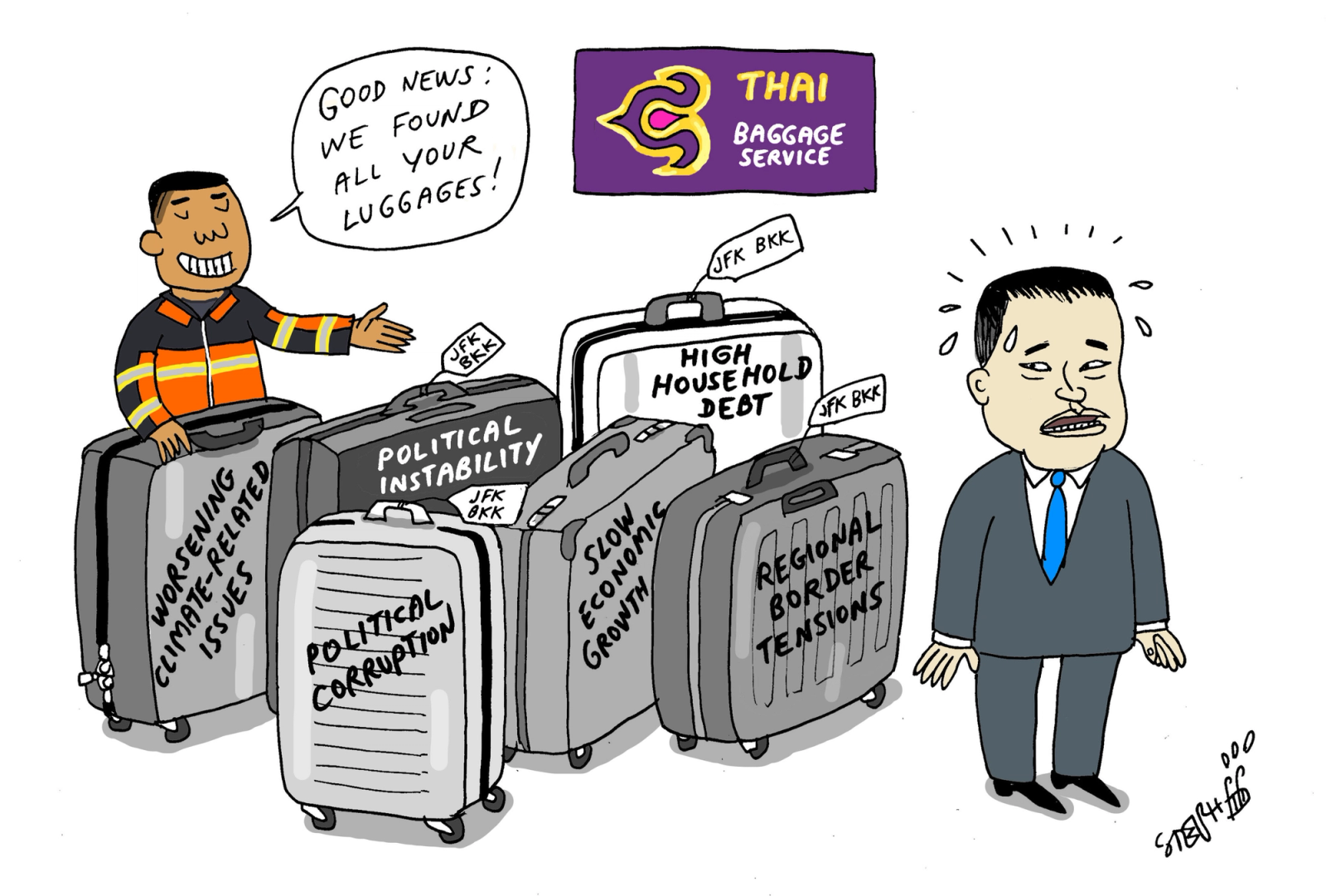
Stephff's world
Powering growth, polluting communities
Panel talk, workshop, Monday, 5 Oct, 1:30pm
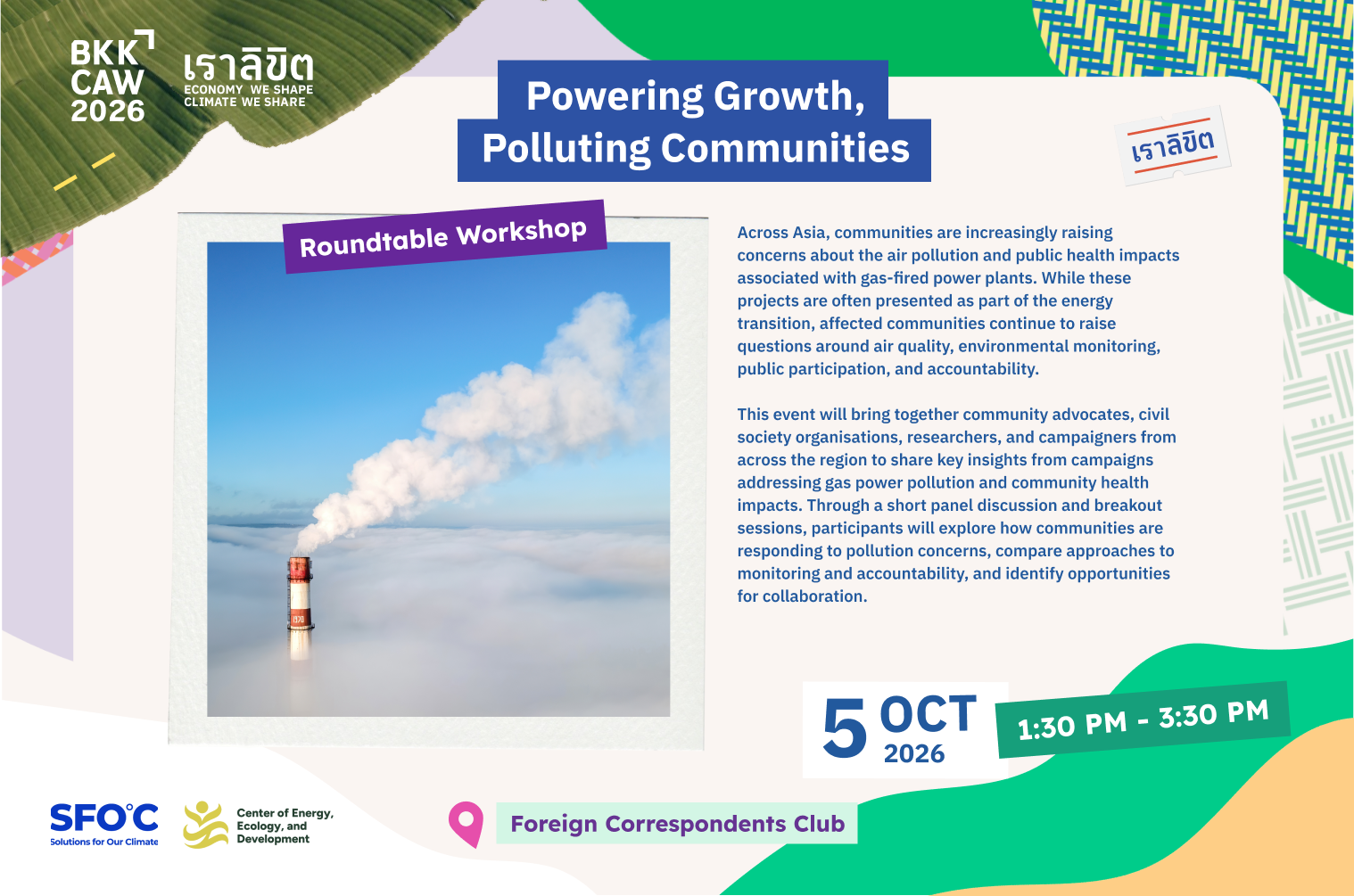
Across Asia, communities are increasingly raising concerns about air pollution and public health impacts associated with gas-fired power plants. While these projects are often presented as part of the energy transition, affected communities continue to raise questions around air quality, environmental monitoring, public participation, and accountability.
This event will bring together community advocates, civil society organisations, researchers and campaigners from across the region to share key insights from campaigns addressing gas power pollution and community health impacts. Through a short panel discussion and breakout sessions, participants will explore how communities are responding to pollution concerns, compare approaches to monitoring and accountability, and identify opportunities for collaboration.
Join us for a lively discussion with:
Patiwat Kanchanawong, environmental researcher, who will talk about how gas-fired power plants and long-term industrial expansion are affecting the environment, public health, and communities across Rayong and Thailand’s Eastern Economic Corridor (EEC);
Daniel Nesan, from the Centre for Research on Energy and Clean Air, to discuss methods and findings from CREA’s studies on health impacts of gas-fired power plants across Asia, and how this evidence can support community advocacy and energy policy;
Bokyong Mun, from Solutions for Our Climate, will share insights and experiences from a campaign in Jeju, South Korea, to stop the build-out of new gas power plants and shed light on the potential negative impacts to the community and environment.
Moderator: Anj Dacanay, Center for Energy, Ecology, and Development.
This session will be in Thai and English (with interpretation available).
Registration is required in advance, and can be done at this link: https://luma.com/m1nbshvk.
Free and open to all.
Bar and restaurant open.
Made in Ethiopia
Documentary, Monday 5 Oct, 7pm
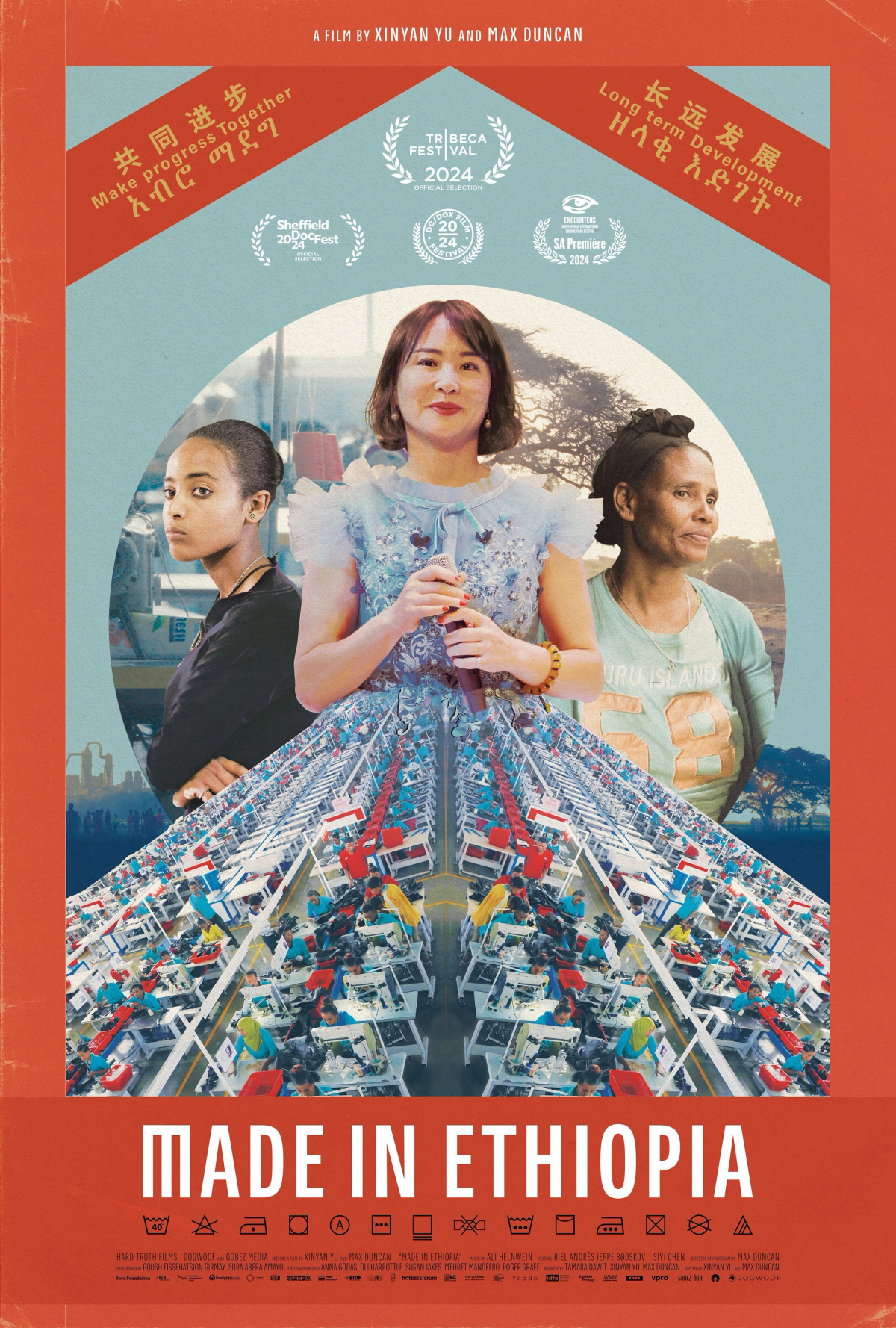
When a massive Chinese industrial park lands in rural Ethiopia, a dusty farming town finds itself at the new frontier of globalization. The sprawling factory complex’s formidable Chinese director Motto now needs every bit of mettle and charm she can muster to push through a high-stakes expansion that promises 30,000 new jobs. Ethiopian farmer Workinesh and factory worker Beti have staked their futures on the prosperity the park promises. But as initial hope meets painful realities, they find themselves, like their country, at a pivotal crossroads.
Filmed over four years with singular access, ‘Made in Ethiopia’ lifts the curtain on China’s historic but little-understood impact on Africa, and explores contemporary Ethiopia at a moment of profound crisis. The film throws audiences into two colliding worlds: an industrial juggernaut fuelled by profit and progress, and a vanishing countryside where life is still measured by the cycle of the seasons. And its nuance, complexity and multi-perspective approach go beyond black and white narratives of victims and villains. As the three women’s stories unfold, ‘Made in Ethiopia’ challenges us to rethink the relationship between tradition and modernity, growth and welfare, the development of a country and the well-being of its people.
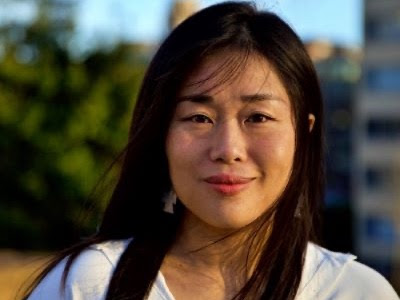
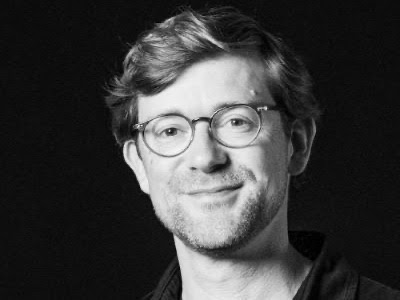
The FCCT is delighted to be able to show this remarkable film, and to host the two people behind it, Xinyan Yu and Max Duncan. Xinyan Yu is an Emmy-winning journalist and filmmaker whose work centres on people often overlooked in the sweep of history and progress. She has directed and produced films for BBC News, PBS Frontline, PBS Nova, NHK, and Channel News Asia. Max Duncan is an award-winning filmmaker, cinematographer and journalist whose work has appeared on the BBC, PBS, The Guardian, The New York Times and Al Jazeera, and at dozens of international film festivals.
The programme will be moderated by BBC South East Asia Correspondent Jonathan Head.
Members who wish to book in advance should email info@fccthai.com or call the FCCT office on 02-652-0580. Non-members can use this link.
Members free, non-members 200 baht; students and local media with ID 150 baht.
Bar and restaurant open.
WWF Living Planet Report 2026: Biodiversity challenges and solutions
Press conference, panel discussion, Tuesday, 6 Oct, 4pm
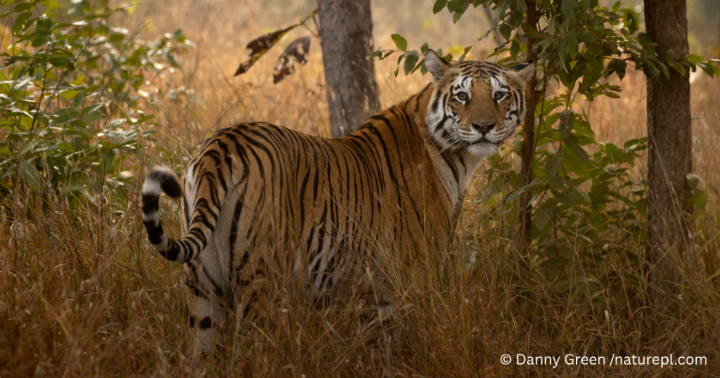
WWF, the World Wildlife Fund, will convene a press conference in Bangkok to share key findings from its Living Planet Report 2026 and explain what they mean for the Asia-Pacific. The discussion will bring together conservation experts, community representatives, businesses and policy institutions to examine the region’s biodiversity challenges and the ‘science of hope’ that can deliver results for people and nature.
The event will spotlight regional biodiversity trends, conservation priorities and the growing implications of nature loss for communities and economies. Speakers will also share examples of how investment, collaboration, community-led conservation and policy changes are translating ambition into positive outcomes across the region. There will be time for spokesperson interviews on request.
Home to extraordinary biodiversity and millions of million who depend on healthy ecosystems, the Asia-Pacific is at a critical juncture. The Living Planet Report 2026 offers an opportunity to understand the pressures nature is facing while showing that collective action by governments, businesses, communities and conservation partners can reverse the downward trend and lead to a more resilient future.
Join us for remarks from:
Dr Martin Kabaluapa Kapinga, chief of WWF’s Country Offices Division;
Dr Sang Lee, WWF’s regional director for Southeast Asia;
Dr Singh Intrachooto, chairman of the board, WWF Foundation.
And a lively discussion with:
Rattaphon Pitakthepsombat, deputy conservation director, WWF Thailand;
Damien Pfirsch, chief commercial officer, Agoda;
Talei Silibaravi, lead project coordinator, Cagimaiwai Women’s Club in Fiji;
Dr Jerome L Montemayor, executive director, ASEAN Centre for Biodiversity.
This event is exclusive and free for invited members of the media and FCCT members.
Speaker & panellist profiles:
Dr Martin Kabaluapa Kapinga leads WWF’s work to strengthen the performance, governance and impact of country programmes in key geographies. Formerly WWF’s Congo Basin director, he brings over three decades of experience in conservation, sustainable agriculture, food security and resilience building. His career includes senior roles with the UN’s World Food Program and Oxfam.
Dr Sang Lee leads WWF’s programme for continental Southeast Asia, and has over 15 years of experience at the intersection of nature, climate and equity. Before joining WWF, she held leadership positions with USAID across Asia and the Caribbean, and directed an environmental education program at the University of California, Berkley.
Dr Singh Intrachooto is an award-winning architect, designer and sustainability innovator who brings design, science and creativity to advance sustainable solutions. He is chief advisor at the Research and Innovation for Sustainability Center, Chief of Nextopia at Siam Paragon, and an associate professor of building innovation at Kasetsart University in Bangkok. Founder of the pioneering eco-design firm Osisu, he has chaired WWF Thailand Foundation since 2024.
Rattaphon Pitakthepsombat has over 30 years of experience working in sustainable natural resource and wildlife biodiversity management, with extensive field expertise in Thailand and the Mekong region. His work focuses on community-based resource management, climate change adaptation, watershed management, ethno-biodiversity conservation, and stakeholder engagement. He has worked with WWF, IUCN, USAID and UNDP.
Damien Pfirsch leads Agoda’s strategic partnerships, key accounts and government affairs, building collaborations across business, government and public sectors. He brings extensive experience from various sectors, such as travel, technology and business, including leadership roles with Minor International, Exotissimo Travel and Keen Media.
Talei Silibaravi is an iTaukei youth leader, mother, and climate advocate from Kavewa Island in Fiji’s Macuata Province. As lead project coordinator for Cagimaiwai Women’s Club and president of Macuata’s Youth Council, she champions youth and women-led climate action, environmental stewardship, and community development. She brings local knowledge, priorities, and perspectives to talks on conservation, climate leadership and ocean ecosystems.
Jerome Montemayor is executive director of the ASEAN Centre for Biodiversity, advancing regional coordination for biodiversity conservation and equitable use of natural resources. A development professional with over 30 years, his work spans conservation, climate action, education and sustainable development across the Philippines and Asia.
Register by email: Oranitb@wwf.or.th
This event is free for invited members of the media and FCCT members.
Bar and restaurant open.
Rebuilding Blocked: Discriminatory bans on mosques before & after Myanmar quake
Report launch, Wednesday, 7 Oct, 10.30am
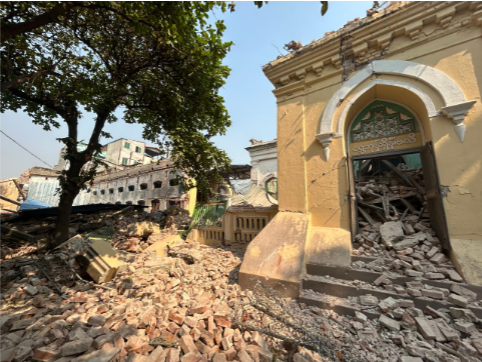
A new report by the Burma Human Rights Network documents how discriminatory government restrictions on the construction, repair and renovation of mosques left Muslim communities unable to address serious structural risks before the huge earthquake in Myanmar in March 2025. It says the moves increased the damage and destruction those religious buildings experienced. The report says the same discriminatory system continues to obstruct demolition, repair and reconstruction after the disaster. BHRN documented 180 mosques and other Islamic buildings affected by the quake in 29 townships. At least 670 Muslims died when these mosques and other religious buildings collapsed.
Blocked from Rebuilding: Myanmar Junta Restrictions on Mosque Repair and Reconstructiondocuments years of delayed or denied repair applications, unclear and inconsistent approval procedures, demands for land documents that some historic mosques did not possess, and reliance on personal connections and unofficial payments to make much needed repairs. After the quake, Muslim communities also faced delays in clearing debris, demolishing unsafe structures, repairing damaged buildings, and rebuilding destroyed mosques. By September 2026, some communities had secured permission to undertake repairs or reconstruction, but many applications remain unresolved and some worshippers are still using temporary prayer spaces.
The report says these restrictions violated the rights of Muslim communities to freedom of religion and belief, undermined the principle of equal treatment, and prevented or delayed work needed to address known safety risks. The press conference and report launch will examine the consequences of these restrictions, the barriers Muslim communities face more than a year after the quake, and the steps international actors should take to support safe reconstruction, equal access to recovery assistance, and the protection of Muslim religious sites in Myanmar.
Join us for the report launch and discussion with:
Kyaw Win, executive director, Burma Human Rights Network, which conducts research and advocacy on human rights in Myanmar;
May Thiri Khin, MA candidate, Mahidol University.
Moderator: Phil Robertson, director, Asia Human Rights and Labour Advocates, and FCCT board member.
Free and open to all.
Bar and restaurant open.
The Collapse of Rural Agrarian Societies under World Bank-IMF Policies
Public seminar, press conference, Wednesday, 7 Oct, 2.30pm
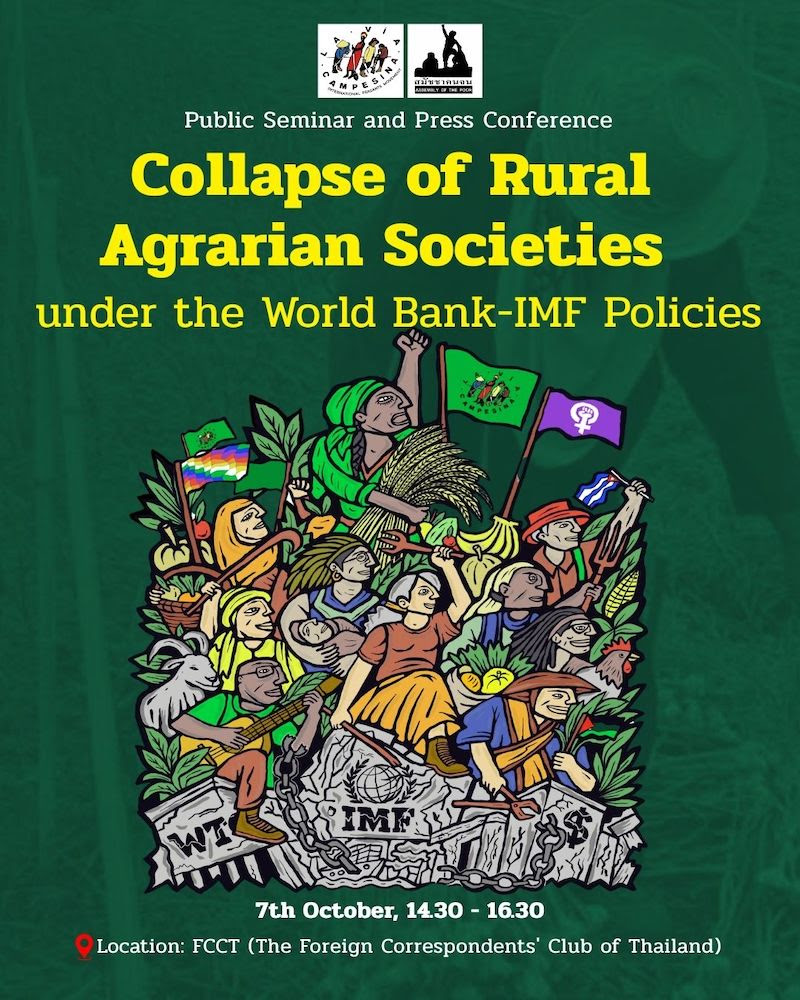
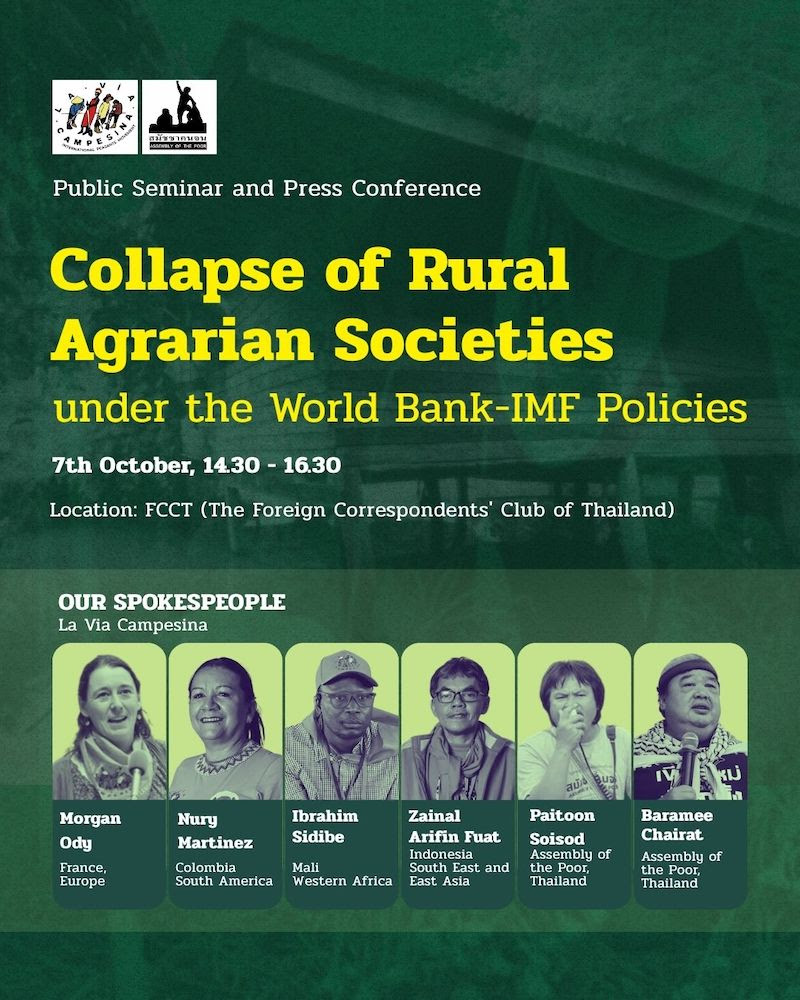
From October 12-18 the World Bank and the International Monetary Fund (IMF) will also hold their annual meetings in Bangkok. This annual meeting of the Bretton Woods twins is taking place against a grim global backdrop. According to the UN Trade and Development, half of the world's population now lives in countries with severe debt that their elected governments owe to these international financial institutions. Most countries in the Global South spend more on debt servicing than providing and funding public welfare and social security programs.
States that are in debt to the IMF and World Bank have also been coerced to move towards a free-market model in which, under the garb of austerity, public welfare programs and social security programs are being steadily rolled back, and an emphasis is placed on privatization, deregulation and disinvestment. These decisions have catastrophic consequences for the rural and urban working class, who are already reeling under the impact of high inflation, rising food, fuel and fertilizer prices, made worse by disruptions caused by endless wars and climate catastrophes. This despair is reflected in the alarming levels of household debt reported by rural communities around the world, including Thailand, which in itself is an endless and vicious cycle that only worsens with time.
La Via Campesina cannot ignore this moment of great upheaval in the world, and we will be voicing our concerns and demands loudly while in Thailand. On October 7, the Assembly of the Poor —the LVC organization in Thailand – will hold a seminar and press conference at the FCCT in Bangkok. On behalf of all members of La Via Campesina, we will outline the concerns of rural communities worldwide regarding the financialization and neo-liberal policies promoted by the World Bank and the IMF, and announce our six-point demands to end the debt crisis and build food sovereignty.
Speakers:
Morgan Ody, general coordinator of La Via Campesina, from France, member of Confederation Paysanne;
Nury Martinez, LVC International Committee, member of Colombian Agricultural Workers and Peasants Union, Fensuagro (will speak in Spanish);
Ibrahim Sidibe, LVC International Committee, member of Malian Peasant Network CNOP (in West Africa, will speak French);
Zainal Arifin Fuat, Indonesia, LVC International Committee, member of Serikat Petani Indonesia (Indonesian Peasants Union);
Paitoon Soisod, secretary-general, Assembly of the Poor, Thailand (will speak Thai).
Baramee Chairat, Assembly of the Poor, Thailand, senior member of La Via Campesina (will speak Thai).
Registration: https://forms.gle/7F26eLwqtUoqpudj9.
Free and open to all.
Bar and restaurant open.
Witnesses to History: Thammasat crackdown 50 years ago
Reshowing of FCCT panel discussion in 2016, Wednesday, 7 Oct, 7pm
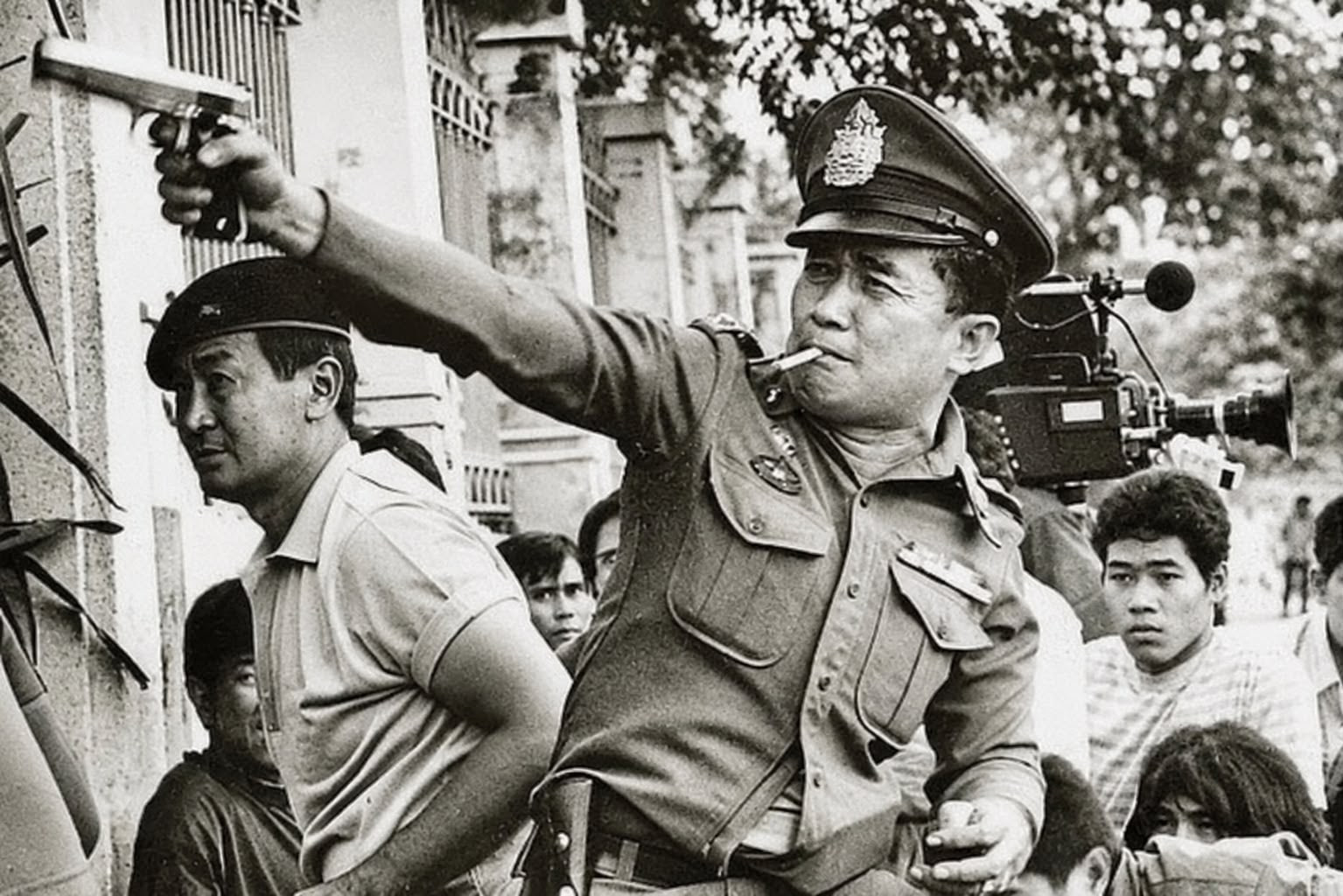
Policeman firing into Thammasat campus, 6 October 1976. (Kraipit Phanvut, UPI)
Early on the morning of 6 October 1976, a violent assault was sanctioned on Thammasat University. Rightist groups laid siege to the campus, and set about shooting, beating and lynching students. Although some shots were certainly fired from inside Thammasat, the orgy of political violence that day was one-sided and ranks as some of the very worst seen in Bangkok. Students were hanged from trees at Sanam Luang and mutilated. Bodies were piled on top of each other and immolated in public. Border Patrol Police fired a recoilless rocket through the university’s front gates, while ordinary police took pot shots through the campus railings. Students were rounded up, stripped to the waist, bound and made to lie face down. Those with spectacles had them smashed.

By official count, some 45 to 49 people died, but many believe the true figure was at least double that. Apart from the dead and injured, some 3,000 students were arrested. Subsequently, at least 3,500 students fled to the forests to hide out, and of these over 1,000 joined the Communist Party of Thailand. It was a watershed moment in Thailand’s political history, suspending attempts to establish constitutional democracy that began three years earlier in the aftermath of more political violence. The toll in 1976 will never be certain, but some believe the actual number of dead is less significant than the manner of their killing. Officially, more people may have died in political violence on the streets of Bangkok in 1973 (70), 1992 (52) and 2010 (91).
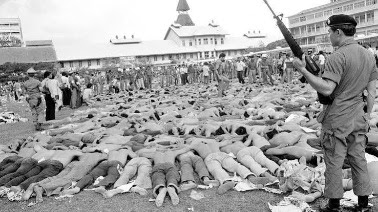
Ten years ago, the FCCT assembled a stellar panel of witnesses to that unforgotten and momentous day to attempt to give it some historical perspective four decades later. They included three outstanding Thai academics with very personal perspectives on that terrible day, and three foreign journalists whose lives were permanently changed by what they witnessed.
Thongchai Winichakul, professor emeritus of Southeast Asian history at the University of Wisconsin, was a student activist at Thammasat during the events of October 1976. Following the massacre, Thongchai was imprisoned for two years. After his release, he completed his degree at Thammasat, did a PhD at the University of Sydney and, in 2001, became a full professor. His book, Siam Mapped: A History of the Geo-Body of a Nation, published in 1994 on the historiography of nationhood in Thailand, is considered as a major work in the field of Thai studies.
Charnvit Kasetsiri, rector of Thammasat University from 1994 to 1995 and its professor emeritus of history is one of Thailand’s most distinguished historians. His books include ’The Rise of Ayudhya: A History of Siam in the 14th and 15th centuries’ (OUP, 1976).
Chaiwat Satha-Anand, a professor of political science at Thammasat, was a junior lecturer there in 1976. An expert on Thailand’s troubled south, he was the founder and director of the Thai Peace Information Centre. He was a key figure in the National Reconciliation Commission set up in 2005 by Prime Minister Thaksin Shinawatra under chairmanship of Anand Panyarachun.
Neal Ulevich, the photographer from The Associated Press who won a Pulitzer for spot news photography that day with unforgettable "photographs of disorder and brutality in the streets of Bangkok".
Claes Bratt covered the political events of 1976 working for UPITN, which was co-owned by UPI, ITN, and ABC News, and became WTN. He also filed for radio on Swedish Broadcasting Corp.
Derek Williams, of Asiaworks, covered Thammasat for CBS News. A veteran of numerous battles in Cambodia and Vietnam, and later Tiananmen Square, Williams looked back on 6 October 1976 as the most horrific day of his life. “I cannot think of another event this is so burned in my memory, and I have seen some bad stuff,” he said.
Moderator: Dominic Faulder, FCCT board member and Nikkei Asia associate editor.
The audience will be invited to make comments after Wednesday’s reshowing.
Members who wish to book in advance should email info@fccthai.com or call the FCCT office on 02-652-0580. Non-members can use this link.
Members free, non-members 200 baht; students and local media with ID 150 baht.
Bar and restaurant open.
The Invisible Workforce: People building clean energy in South and Southeast Asia
Panel talk, photo show, Thurs, 8 Oct, 2pm
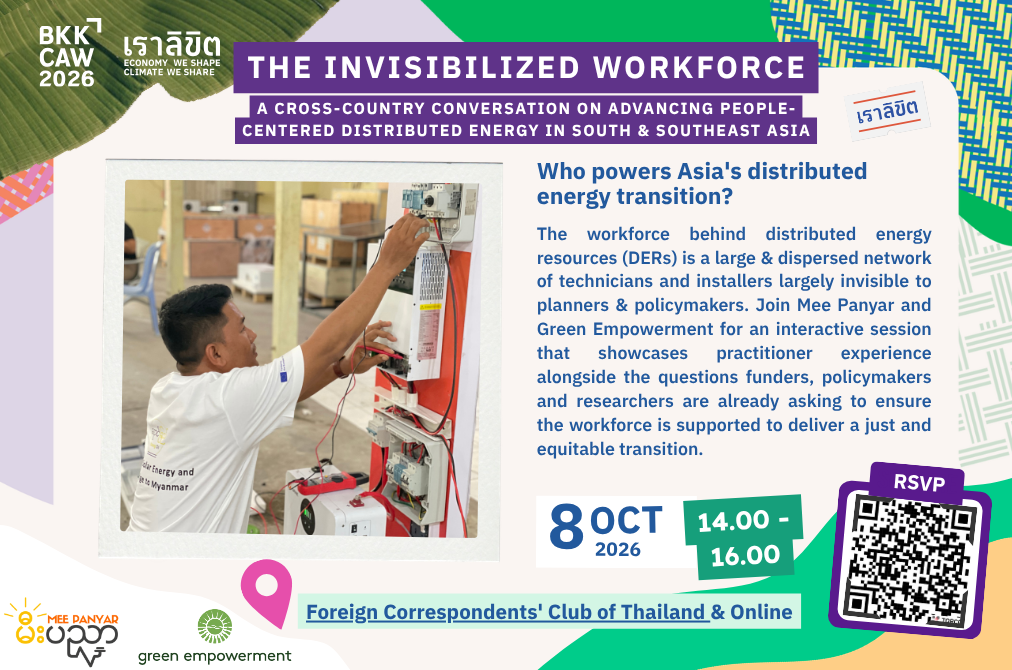
Across South and Southeast Asia, a growing share of clean energy is small-scale solar built close to where people live, often in places the main grid does not reliably reach. Each system is small, but there are many of them spread over wide areas, and installing and running them takes a large, dispersed workforce. Small-scale solar accounts for two in every three solar jobs worldwide, according to the International Energy Agency. Yet this workforce is rarely heard when decisions about the sector are made.
Without that perspective, energy targets and training programmes are often planned with an incomplete picture of who is available to do the work and on what terms. This panel brings together organizations working alongside this workforce in different countries to compare what they see on the ground, and to ask what needs to change so that policy and funding keep pace with the people building the energy transition.
A photo exhibition of distributed energy work from across the region will run alongside the panel, and questions from the audience, in the club and online, will guide the discussion. This event is hosted by Mee Panyar and Green Empowerment, as part of Bangkok Climate Action Week.
Speakers:
Natasha Allen, founder and managing director, Mee Panyar;
Noorulain Masood, founder and CEO, Sath-CSIDC;
Sheryl Estella, academy manager, New Energy Academy Philippines;
Moderator: Ayu Abdullah, co-founder and executive director, Energy Action Partners.
Free entry. But please register at https://forms.gle/oqYzqM4mzdE8dLFP7. The session will also be streamed online for registered participants. Coffee and tea will be served, with the bar and restaurant open.
Free and open to all.
Bar and restaurant open.
The World Bank meetings in Bangkok: Financing development or fuelling the climate crisis?
Panel discussion, Friday, 9 Oct, 9.30am
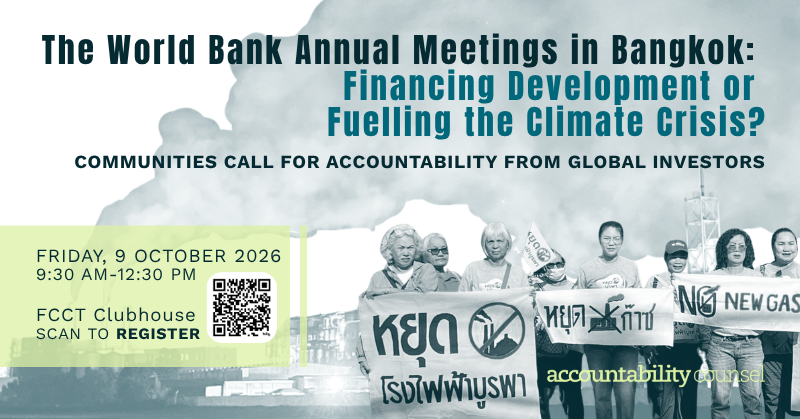
Accountability Counsel is bringing together environmental defenders from Indonesia, India, Thailand, and the Philippines to discuss the interconnection between energy and extractive projects, development finance, climate crisis, and accountability. Billions of dollars are being invested in energy, extractives, and infrastructure projects around the world. But what happens when these investments have consequences for the peoples and communities living alongside them?
With the World Bank Group Annual Meetings taking place in Bangkok from October 12-18, this special half-day event brings together environmental defenders and their allies from Indonesia, India, Thailand, and the Philippines to share their experiences and discuss how investors and development finance institutions should be held accountable when projects cause environmental destruction, and intensify the climate crisis.
The discussion will explore the challenges communities face in preventing, mitigating and obtaining remedies for environmental and human rights harm, as well as practical accountability pathways that communities and defenders can use. Speakers will also discuss what the World Bank Group and other development finance institutions can do to better protect people and the planet.
Join us for three panel discussions:
Panel 1: Thai Communities Resisting Climate False Solutions
Community representatives from Prachinburi, Chachoengsao, and southern border provinces experiencing environmental destruction and human rights violations linked to energy projects will share their stories and reclaim the narrative for people-led climate justice.
Speakers:
Sutharee Wannasiri, Accountability Counsel;
Ridtidat Boonyaburanakit, Strong Prachinburi Community Network;
Ueangfa Chamket, Chachoengsao Re: Power;
Abdulloh Awae and Aemboerin Samae, Civil Society Assembly for Peace (CAP-Nature).
Panel 2: Holding Investors Accountable for Harming Our Planet
Community advocates from Indonesia and the Philippines will share their experiences challenging environmental and climate change impacts linked to internationally financed projects — and explain how communities can use accountability mechanisms to seek remedies.
Speakers:
Margaux Day, Accountability Counsel;
Martha Doq, Perkumpulan Nurani Perempuan;
Yuvensius Stefanus Nonga, WALHI Nusa Tenggara Timur;
Aaron Pedrosa, Philippine Movement for Climate Justice.
This will include a short demonstration of the Accountability Toolkit, which helps communities navigate financial institutions' accountability mechanisms, followed by the first public announcement of its upcoming AI Accountability Advisor.
Panel 3: Money, Power, and Planetary Harms: The World Bank Must Be Held Accountable.
As the World Bank and government representatives meet in Bangkok, advocates will share a concrete list of actions the World Bank needs to take to be accountable to peoples and the planet.
Speakers:
Tala Batangan, Coalition for Human Rights in Development;
Joe Athialy, Centre for Financial Accountability;
Stephanie Amoako, Accountability Counsel
The talks will be in Thai, English and Bahasa Indonesia. Simultaneous translations will be provided for in-person participation.
This is not an FCCT event. Free and open to all.
Register here to reserve your seats or email: info@accountabilitycounsel.org
The session will also be streamed online for registered participants. Coffee and tea will be served, with the bar and restaurant open.
Free and open to all.
Bar and restaurant open.
Geoeconomics in an age of fragmentation: Lunch talk with the EU Commissioner Valdis Dombrovskis
Tuesday, 13 Oct, 12 noon – 1.30pm
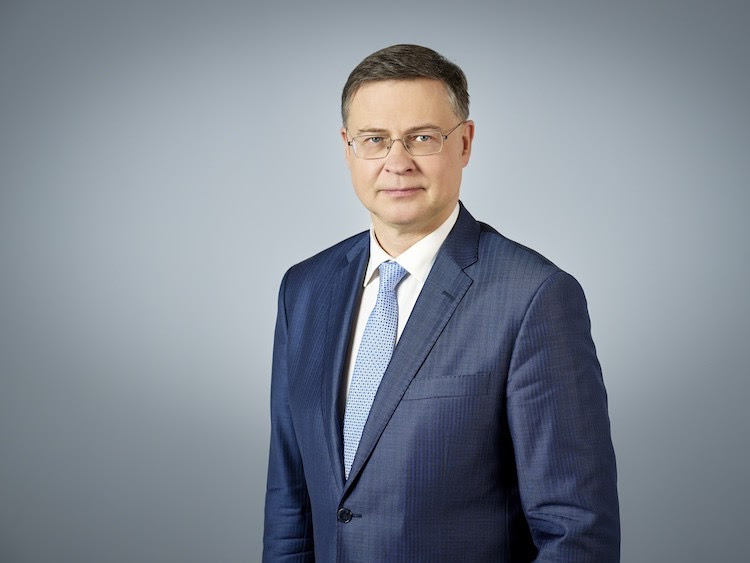
Geopolitical tensions and structural economic shifts are reshaping the global economy. Persistent global imbalances, high public debt, financial vulnerabilities, demographic pressures, and slower growth are creating new challenges for policymakers. European Commissioner Valdis Dombrovskis joins the FCCT to discuss how the European Union is navigating this challenging global economic landscape, including the implications of protectionism, economic security, and growing tensions between the world’s major powers. He will explore the outlook for the global economy, EU’s relations with Asia and the European Union’s competitiveness agenda, including efforts to simplify regulation and deepen the single market and capital markets in Europe. The discussion will also address the future of the international economic and financial system, as well as EU’s continued support for Ukraine.
One of Europe’s most experienced economic policymakers, Valdis Dombrovskis has been the European Commissioner for Economy and Productivity, as well as Implementation and Simplification since December 2024. His portfolio includes the coordination and implementation of the EU’s economic policies, as well as overseeing the reduction of administrative burden and ensuring better implementation of EU rules. From 2019 to 2024, he served as the executive vice-president of the European Commission responsible for An Economy that Works for People and was also in charge of Trade. He previously served as vice-president of the European Commission from 2014 to 2019, overseeing the Euro and Social Dialogue, as well as financial stability, financial services, and the Capital Markets Union.
He is Latvia’s longest-serving head of government with three terms as Prime Minister (2009–2014). He has also been finance minister, a member of the Latvian Parliament and European Parliament. Before politics, he was the chief economist at the Bank of Latvia, as well as a research assistant at Mainz University, the Institute of Solid-State Physics in Latvia and University of Maryland. Valdis Dombrovskis was born on August 5, 1971.
Interviewer: Dr Fuadi Pitsuwan, from Thammasat University.
Moderator: Panu Wongcha-um, president of the Foreign Correspondents’ Club of Thailand.
Registration here.
Free and open to all. Registration required.
Bar and restaurant open.
Britain, Thailand and a changing Southeast Asia – a conversation with the new British ambassador to Thailand
Evening talk, Monday, 19 Oct, 7pm
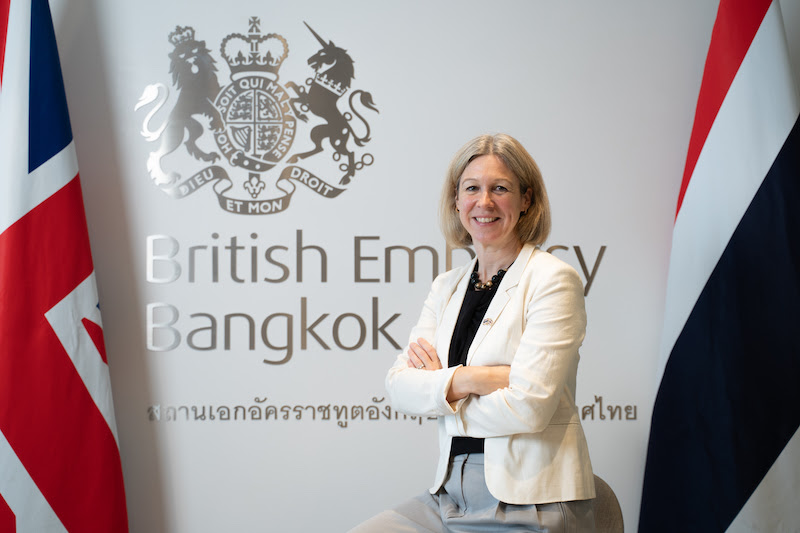
Thailand and the United Kingdom share a long-standing relationship spanning trade, investment, education, tourism, security and close people-to-people ties.As both countries navigate a more fragmented and uncertain international landscape, the relationship is expanding into areas such as clean energy, technology, climate action and regional security.
Britain is also seeking a deeper role in Southeast Asia, a region increasingly central to global economic growth and geopolitical competition. How does the UK view its evolving partnership with Thailand? And where does the country fit within Britain’s wider engagement with ASEAN and the Indo-Pacific?
In her first appearance at the FCCT, British Ambassador Nicola Pollitt will discuss the opportunities, challenges and priorities shaping this next chapter.
Moderator: Jonathan Head, BBC Southeast Asia correspondent.
Members who wish to book in advance should email info@fccthai.com or call the FCCT office on 02-652-0580. Non-members can use this link.
Members free, non-members 400 baht; students and local media with ID 150 baht.
Bar and restaurant open.
Heritage Hotels of Asia
PREMIUM book launch with Ken Barrett, Eric Hallin and Jaffee Yee Yeow-Fei, Wednesday, 21 Oct, 7pm
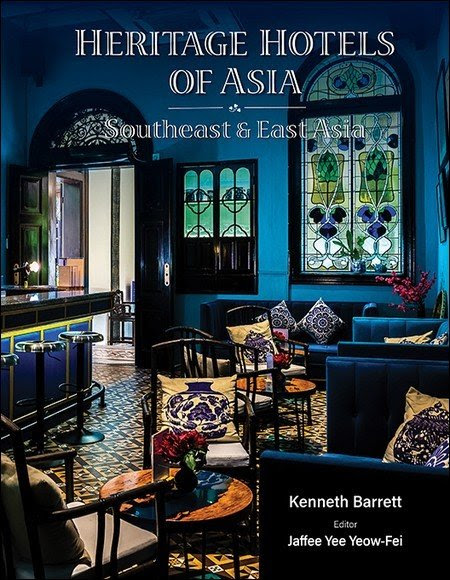
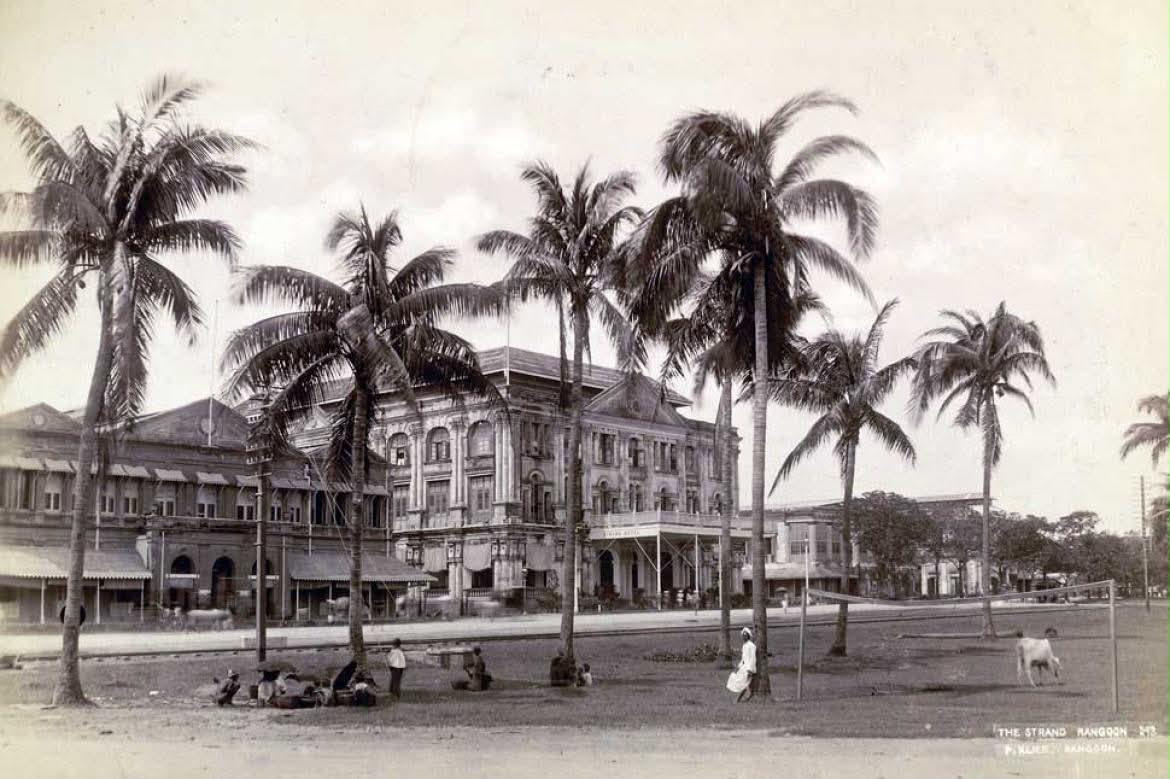
‘Heritage Hotels of Asia: Southeast & East Asia’ is a passion project for its editor, Jaffee Yee Yeow-Fei. His book is in many ways a grand tour of a region that opened up to international travelers after the Suez Canal was commissioned in 1869 and steamships helped usher in modern travel.
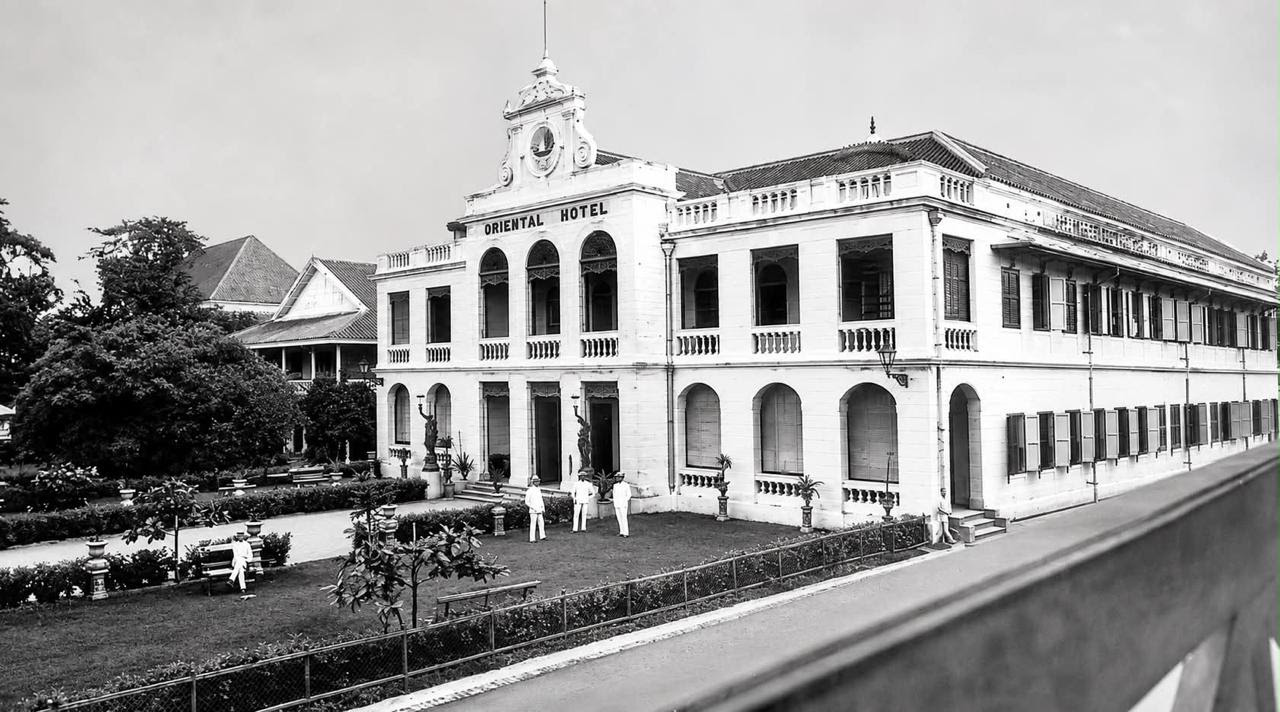
“Grand hotels and history are inseparable,” writes Andrew J Woods. “These remarkable properties are far more than elegant places to stay. Each reflects the rich tapestry of the country, region or city in which it stands. Through architecture, art, tradition and carefully preserved historical references, they connect travellers with their surroundings while immersing them in the atmosphere of another era.”
The first volume in this series covered the inroads made by Europeans into India in the 19th century. The grand colonial hotel tradition was forged by Spence’s Hotel in Calcutta in 1830. This second volume takes in 56 storied properties that followed in 13 other countries, documenting the architecture, people and stories behind many of Asia’s most iconic heritage hotels.
These include The Strand in Yangon, Malaysia’s Eastern & Oriental, Cheong Fatt Tze Mansion and Hotel Majestic, plus Singapore’s Raffles, Goodwood Park and Fullerton.
“Unlike many books of this genre, which are picture-heavy, this one is nicely balanced with lovely pictures and also detailed yet concise history and context for every property featured,” said Nirmal Ghosh, a former FCCT president.

Speakers:
Author Ken Barrett is a London-born journalist and writer who has lived in Asia for the best part of 40 years, much of that in Bangkok, with stints in Hong Kong and Singapore. He has visited 60 countries on assignment, and launched, edited or contributed to numerous publications in the business, travel, industrial and consumer sectors. He has written extensively on architecture and building technology, and has a strong interest in architectural heritage conservation. Barrett is the author of ’22 Walks In Bangkok: Exploring the City’s Historic Back Lanes and Byways’, which was launched to great acclaim at the FCCT in 2019.
Eric Hallin is a Swedish hotelier with more than five decades in the hospitality industry, much of it spent in Asia. He has a particular passion for hotels with a strong sense of place, character and history. He has held senior positions in Thailand, the Maldives and Vietnam, managing and developing a wide range of hotels and resorts, including business, luxury and experiential properties. Highlights include his years with Dusit Hotels & Resorts and Six Senses. Hallin has been general manager of The Legend Chiang Rai Boutique River Resort & Spa since 2022.
Editor Jaffee Yee Yeow-Fei is an award-winning publisher, editor, art consultant and travel marketing consultant with more than 40 years of international experience. Based primarily in Thailand, he is deeply involved in documenting, preserving and promoting the culture, arts and tourism in the Greater Mekong Subregion. He has collaborated with global media institutions like McGraw-Hill Book Company and CBS International Publishing. His independent ventures include Myer Publishing in Hong Kong and Thailand’s Knowledge Media Group. He is a veteran FCCT member of 42 years.
Moderator: Dominic Faulder, FCCT board member and Nikkei Asia associate editor.
Copies of the book will be available on the night.
Members who wish to book in advance should email info@fccthai.com or call the FCCT office on 02-652-0580. Non-members can use this link.
Members free, non-members 600 baht; students and local media with ID 200 baht.
Bar and restaurant open.
The Strongman and the Last Days of the Khmer Rouge
Film, Wednesday, 28 October, 7pm
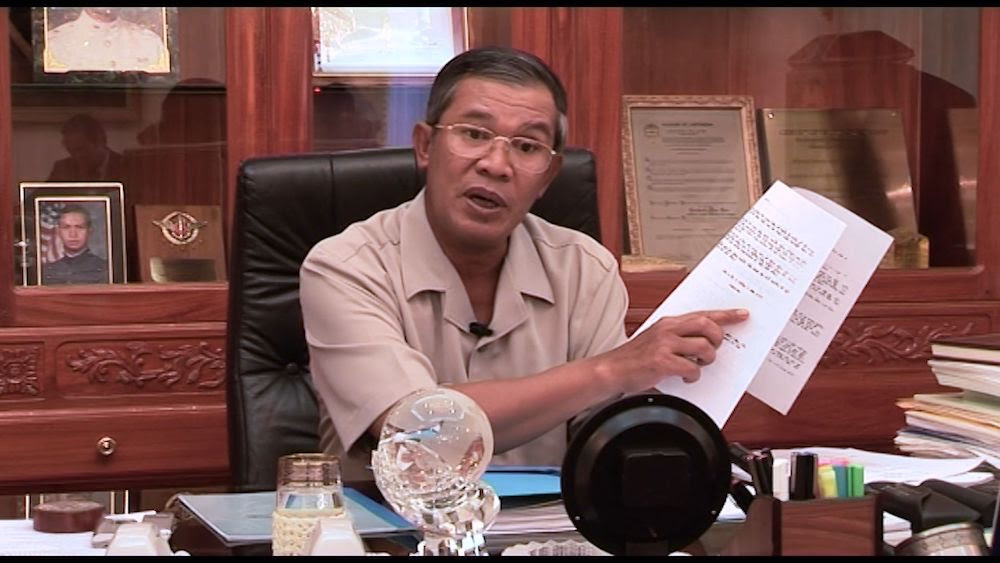
From the frontlines of the conflict against the Khmer Rouge to the backrooms of political power in Phnom Penh, legendary documentary maker James Gerrand provides rare behind-the-scenes views of Cambodian strongman Hun Sen’s battle to gain the upper hand against his former allies, Pol Pot and the Khmer Rouge. In his late teens, Hun Sen was originally recruited into the Khmer Rouge as a guerrilla fighter. Later, he defected to the side of the Vietnamese invaders who expelled the Khmer Rouge in 1979. As Prime Minister from 1985 to 2023, Hun Sen led the Cambodian People’s Party (CPP) and cemented his power while guiding Cambodia’s political and economic development, amid accusations of serious corruption and human rights violations.
“The Strongman and the Last Days of the Khmer Rouge” presents a fascinating insight into how Hun Sen has wielded political power. This story is told via in-depth interviews with Hun Sen and his colleagues and political adversaries. The film draws upon filmmaker James Gerrand’s own archive of footage shot in Cambodia over the past 40 years. It is a revealing portrait – showing Hun Sen’s principal character traits, his political savvy and capacity for both charm and ruthlessness.
James Gerrand has written for publications including the Far Eastern Economic Review, Bangkok Post, The Australian, Nation Review, National Times, and the Asian Wall Street Journal. During the 1970s and 1980s, he filmed and produced news and current affairs reports for Visnews (UK for worldwide syndication), CBS (America), ABC (America), ABC (Australia) and SBS-TV (Australia).
After arriving in Phnom Penh in 1967 in a canoe, a voyage that became the basis of his film ‘Mekong Downstream’, Gerrand based himself in Phnom Penh and covered the outbreak of the civil war that eventually brought Pol Pot to power. He began his first news filming of the war as a stringer for Visnews and CBS (America). From this intense involvement in the Cambodian tragedy, came his seminal documentary study ‘Khmer! Khmer! Cambodia in Conflict’ (1972). His commitment to filming and documenting every major twist and turn in Cambodia’s tortured history has never waned. Returning to the region every year since the fall of Pol Pot in 1979, he has worked independently to produce his landmark documentaries ‘Cambodia, the Prince & the Prophecy’ (1986), ‘Cambodia Kampuchea’ (1987) and ‘The Last God-King’ (1996), which still stand as among the clearest, most penetrating film studies available that delve down to the roots of modern Cambodian conflicts.
Members who wish to book in advance should email info@fccthai.com or call the FCCT office on 02-652-0580. Non-members can use this link.
Members free, non-members 200 baht; students and local media with ID 150 baht.
Bar and restaurant open.
Burma Soldier
Film screening, panel discussion, Wednesday, 11 November, 7pm
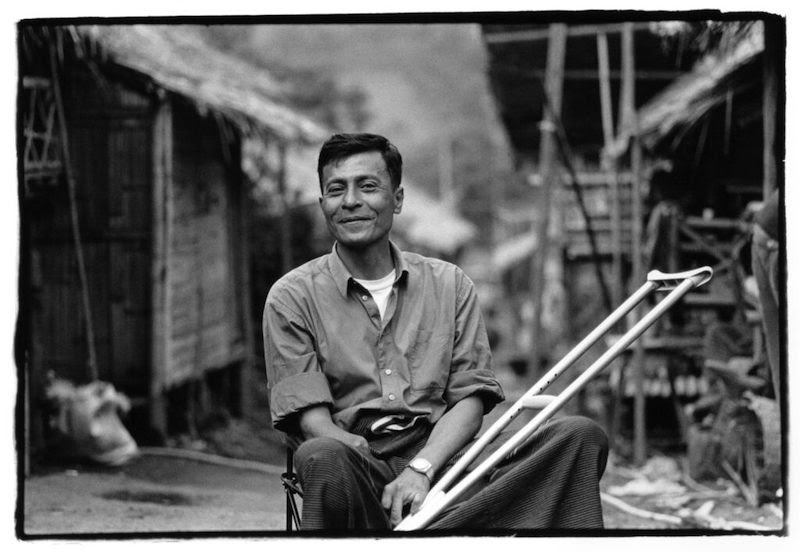
Frontier Myanmar, in association with the Embassy of Ireland in Bangkok, brings the Emmy-nominated HBO documentary Burma Soldier to the FCCT. The film is a powerful expose of Myanmar’s military from an insider. It tells the story of Myo Myint who joined the Myanmar army at 17, seeking the security, respect and employment it promised. After losing a limb to a landmine, he turned against the military regime and joined the pro-democracy movement. Combining interviews, archival footage and photographs, much of it smuggled out of the country, Burma Soldier traces Myanmar’s history from independence in 1948 and examines how decades of military rule shaped the country. More than ever, the film’s story remains relevant to understanding Myanmar today.
Narrated by Colin Farrell with music by U2, Burma Soldier won the Grand Jury Prize for Best Documentary at the United Nations Association Film Festival. It was also nominated for an Irish Film & Television Academy (IFTA) Award for Best Feature Documentary and nominated for an Emmy.
Variety Magazine said that: “HBO’s documentaries have a way of compelling us to take a look at parts of the world the rest of the media tends to forget... The strongest elements come from Myo Myint first-person accounts of the horrors he witnessed.”
Following the film, a panel of experts will discuss the movie, and how civil war and military rule have affected Myanmar and undermined the ability of different factions in the country to reconcile, compromise and resolve problems.
Join us for a thought-provoking discussion with:
Thu Thu Aung, editor-in-chief at Frontier Myanmar;
Kyaw Kyaw, researcher, Myanmar Defence and Security Institute, medical doctor, former Myanmar military officer;
Agnes Mary, counselling psychologist from Myanmar specialising in trauma;
Nic Dunlop, co-director of Burma Soldier and features editor at Frontier Myanmar.
Free and open to all.
Bar and restaurant open.
Co-working at the FCCT
Tuesday, 6 Oct, 10am
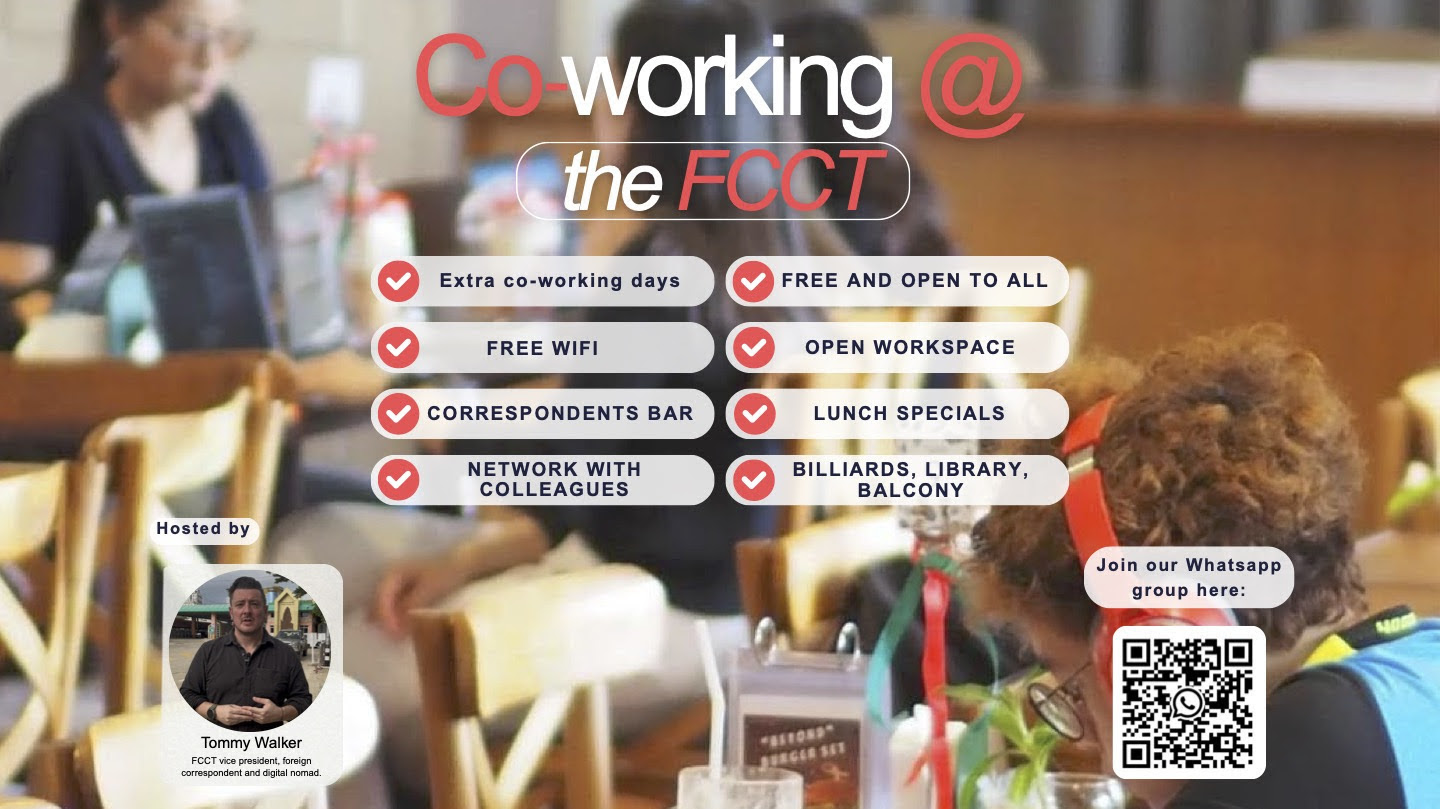
Need a change of scenery from your home office? Join us for a coworking day at the Foreign Correspondents’ Club of Thailand (FCCT) -- a perfect space for working professionals, digital nomads and anyone looking to break free from the home-office routine. Enjoy a spacious, comfortable workspace with dedicated tables, a full restaurant, café and bar and exclusive lunch specials just for this event.
Whether you're tackling deadlines or networking with like-minded professionals, this is an opportunity to be productive in a collaborative, social environment. Come work, connect, and enjoy great food because working remotely doesn’t have to mean working alone.
Hosted by foreign correspondent Tommy Walker.
Free and open to all.
Bar and restaurant open.
Board games night
Tuesday, 6 Oct, 7pm

Join us for a chilled night of board games with The Boring Club. Try your luck with classics like chess and backgammon or modern games including Catan and Pandemic. The bar and restaurant will be open. Try our pizzas from the new pizza oven. The Boring Club meets at the FCCT clubhouse for games every Tuesday at 7pm.
Free and open to all.
Bar and restaurant open.
FCCT pub trivia
Friday, 23 Oct, 7pm

Gather your friends and colleagues for a night of pub trivia at the Foreign Correspondents' Club of Thailand.
Come for a bite and a beverage and test your knowledge. 1,000 baht bar tab up for grabs for the winning team, to be redeemed on the night.
Advanced table bookings encouraged here.
Free and open to all.
Bar and restaurant open.