

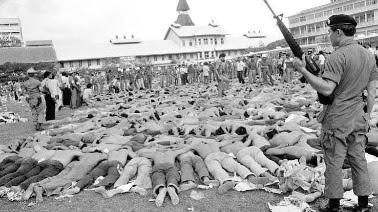
Early on the morning of 6 October 1976, a violent assault was sanctioned on Thammasat University. Rightist groups laid siege to the campus, and set about shooting, beating and lynching students. Although some shots were certainly fired from inside Thammasat, the orgy of political violence that day was one-sided and ranks as some of the very worst seen in Bangkok. Students were hanged from trees at Sanam Luang and mutilated. Bodies were piled on top of each other and immolated in public. Border Patrol Police fired a recoilless rocket through the university’s front gates, while ordinary police took pot shots through the campus railings. Students were rounded up, stripped to the waist, bound and made to lie face down. Those with spectacles had them smashed.
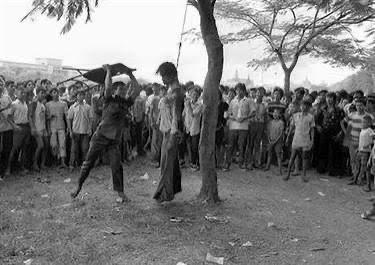
By official count, some 45 to 49 people died, but many believe the true figure was at least double that. Apart from the dead and injured, some 3,000 students were arrested. Subsequently, at least 3,500 students fled to the forests to hide out, and of these over 1,000 joined the Communist Party of Thailand. It was a watershed moment in Thailand’s political history, suspending attempts to establish constitutional democracy that began three years earlier in the aftermath of more political violence. The toll in 1976 will never be certain, but some believe the actual number of dead is less significant than the manner of their killing. Officially, more people may have died in political violence on the streets of Bangkok in 1973 (70), 1992 (52) and 2010 (91).
Ten years ago, the FCCT assembled a stellar panel of witnesses to that unforgotten and momentous day to attempt to give it some historical perspective four decades later. They included three outstanding Thai academics with very personal perspectives on that terrible day, and three foreign journalists whose lives were permanently changed by what they witnessed.
Thongchai Winichakul, professor emeritus of Southeast Asian history at the University of Wisconsin, was a student activist at Thammasat during the events of October 1976. Following the massacre, Thongchai was imprisoned for two years. After his release, he completed his degree at Thammasat, did a PhD at the University of Sydney and, in 2001, became a full professor. His book, Siam Mapped: A History of the Geo-Body of a Nation, published in 1994 on the historiography of nationhood in Thailand, is considered as a major work in the field of Thai studies.
Charnvit Kasetsiri, rector of Thammasat University from 1994 to 1995 and its professor emeritus of history is one of Thailand’s most distinguished historians. His books include ’The Rise of Ayudhya: A History of Siam in the 14th and 15th centuries’ (OUP, 1976).
Chaiwat Satha-Anand, a professor of political science at Thammasat, was a junior lecturer there in 1976. An expert on Thailand’s troubled south, he was the founder and director of the Thai Peace Information Centre. He was a key figure in the National Reconciliation Commission set up in 2005 by Prime Minister Thaksin Shinawatra under chairmanship of Anand Panyarachun.
Neal Ulevich, the photographer from The Associated Press who won a Pulitzer for spot news photography that day with unforgettable "photographs of disorder and brutality in the streets of Bangkok".
Claes Bratt covered the political events of 1976 working for UPITN, which was co-owned by UPI, ITN, and ABC News, and became WTN. He also filed for radio on Swedish Broadcasting Corp.
Derek Williams, of Asiaworks, covered Thammasat for CBS News. A veteran of numerous battles in Cambodia and Vietnam, and later Tiananmen Square, Williams looked back on 6 October 1976 as the most horrific day of his life. “I cannot think of another event this is so burned in my memory, and I have seen some bad stuff,” he said.
Moderator: Dominic Faulder, FCCT board member and Nikkei Asia associate editor.
The audience will be invited to make comments after Wednesday’s reshowing.
Members who wish to book in advance should email info@fccthai.com or call the FCCT office on 02-652-0580. Non-members can use this link.

